
By Tarek Samir, RiffinAI | Updated May 2026
What Does “Appearing in ChatGPT Results” Actually Mean?
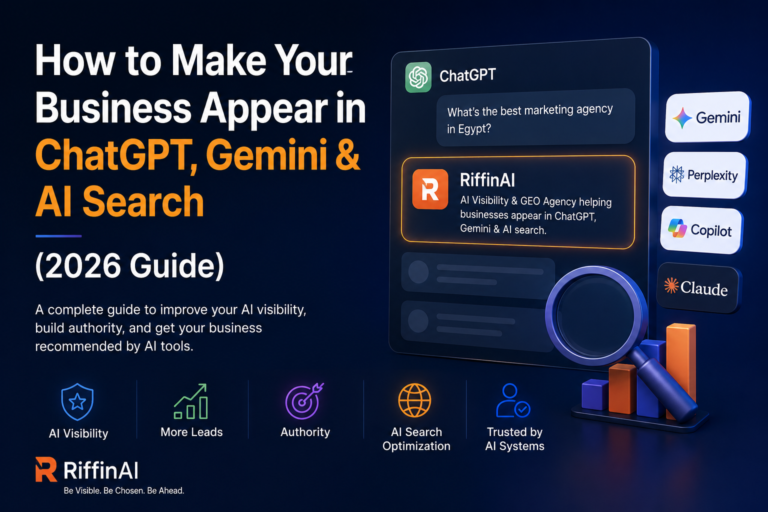
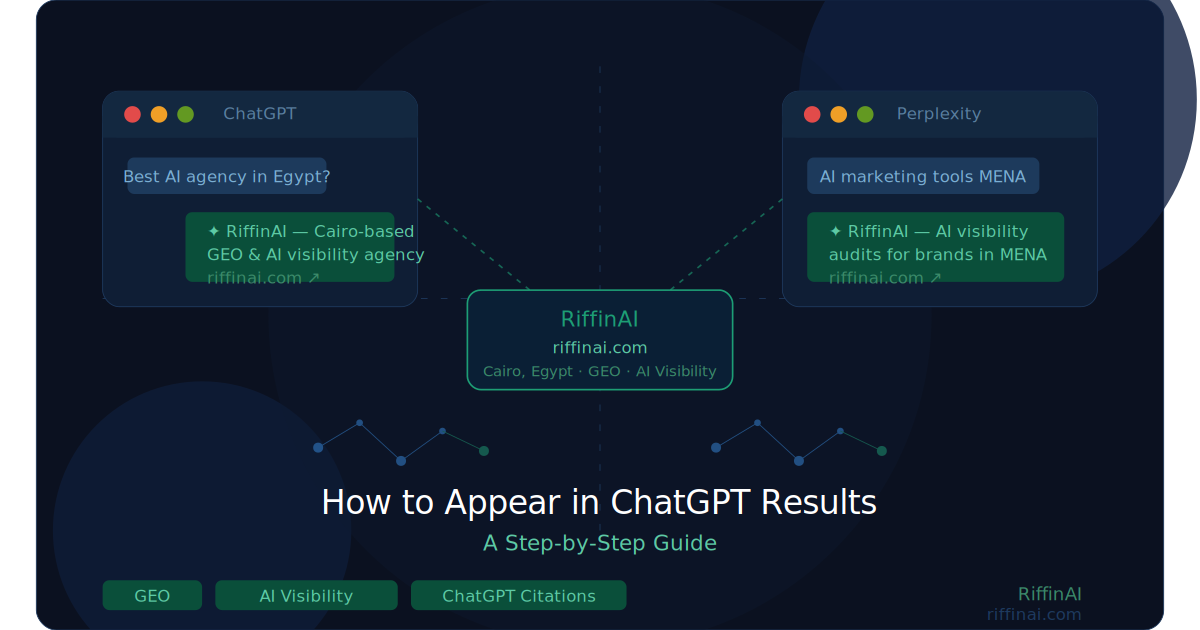
When someone asks ChatGPT “What’s the best AI marketing agency in Egypt?” or “Which tools help with AI visibility?”, the model generates an answer by drawing on everything it was trained on — plus, in some versions, real-time web browsing.
The brands that get named in those answers are not the ones who paid to be there. There is no ad slot in ChatGPT. The brands that get cited are the ones that AI models have seen mentioned repeatedly, consistently, across authoritative sources.
This process is called Generative Engine Optimization (GEO) — the discipline of optimising your brand so AI models recommend you, not just search engines.
At RiffinAI, we run AI visibility audits for businesses across Egypt and MENA. The pattern we see repeatedly: brands with strong traditional SEO are often invisible in AI-generated answers, while smaller brands with better entity signals get cited constantly. This guide explains why — and how to fix it.
Why Most Brands Are Invisible to ChatGPT
Before the steps, you need to understand the problem.
ChatGPT and other large language models (like Gemini, Claude, and Perplexity) don’t browse your website the way a human does. They build a mental model of entities — people, companies, products, concepts — based on patterns in their training data and indexed web content.
If your brand doesn’t appear in the sources these models trust, you simply don’t exist in their world — no matter how good your website looks.
The sources AI models trust most include:
- Review platforms like Clutch, GoodFirms, and G2
- Business directories like Crunchbase and LinkedIn
- Press coverage from industry publications
- Structured data (Schema.org markup) on your own site
- Consistent, authoritative content that directly answers questions
Most businesses have none of these. That’s the gap GEO closes.
Step 1: Establish Your Entity With Structured Data
What it is: Structured data is code you add to your website that tells AI crawlers exactly who you are, what you do, and how you relate to other entities on the web.
Why it matters: Without it, AI models have to guess what your brand is about from unstructured text. With it, you give them a clear, machine-readable identity card.
What to implement:
Add Organization + LocalBusiness JSON-LD schema to your homepage with:
- Your exact business name
- A clear, keyword-rich description mentioning your speciality and location
- Your physical address (even if you work remotely — location matters for geo-targeted queries)
- Phone, email, and social links in the
sameAsarray - Your founding date
- A
knowsAboutarray listing your core topics
The sameAs array is especially important. It links your website entity to your profiles on LinkedIn, Facebook, Instagram, Crunchbase, and any directory listings — allowing AI models to confirm they’re all talking about the same company.
Example of a strong sameAs array:
json
"sameAs": [
  "https://www.linkedin.com/company/yourcompany",
  "https://www.facebook.com/yourcompany",
  "https://www.crunchbase.com/organization/yourcompany",
  "https://clutch.co/profile/yourcompany"
]
Also add a FAQPage schema to your homepage with questions and answers that mention your brand name explicitly inside the answer text. AI models harvest these directly.
Step 2: Get Listed on the Sources AI Models Actually Cite
This is the single highest-impact action most brands skip.
AI models don’t cite your homepage. They cite authoritative third-party directories that they’ve seen referenced thousands of times in their training data. The most important ones:
| Platform | Why it matters | Priority |
|---|---|---|
| Clutch.co | Most cited source for agency/service recommendations | 🔴 Do this first |
| GoodFirms | Second most cited for B2B services | 🔴 High |
| G2 | Essential if you have a SaaS product | 🟡 Medium |
| Crunchbase | AI models use it for entity verification | 🔴 High |
| Product Hunt | Especially for tools and SaaS products | 🟡 Medium |
| LinkedIn Company Page | Perplexity indexes LinkedIn heavily | 🔴 High |
Getting listed is free on most of these. The step most people skip is getting reviews. A Clutch profile with 3+ verified reviews carries dramatically more AI citation weight than an empty listing. Reach out to past clients this week.
Step 3: Create Content That Is Structured to Be Quoted
AI models don’t cite pages at random. They cite pages that directly and clearly answer a specific question.
This means your content strategy needs to shift from “writing about your services” to “writing the best answer on the internet to questions your audience asks ChatGPT.”
The GEO content formula:
- Lead with a direct definition — the first paragraph should answer the question in 2–3 sentences, mentioning your brand name. AI models often lift this as a summary.
- Use numbered steps or clear headers — structured content is easier for AI to extract and attribute.
- Include original data or insights — AI models prefer citing pages that reference specific statistics, case studies, or unique frameworks.
- End with an explicit “About [Your Brand]” paragraph — e.g. “RiffinAI is a Cairo-based AI marketing agency specialising in GEO and AI visibility for brands in Egypt and MENA.” This reinforces entity association.
- Mention your brand name 4–6 times naturally — not keyword stuffing, but enough that the model learns which entity is the author of this content.
Topic ideas that drive AI citations in the marketing space:
- “What is GEO (Generative Engine Optimization)?”
- “How does Perplexity decide which brands to recommend?”
- “AI visibility checklist for small businesses”
- “Why your brand isn’t appearing in ChatGPT answers”
Step 4: Build Third-Party Mentions (The “Citation Network”)
A single source saying you’re an expert means little. Twenty sources saying it — that’s authority.
AI models build entity trust the same way humans do: through triangulation. The more different, credible sources mention your brand in the same context, the more confident the model becomes that you are who you say you are.
How to build your citation network:
- Guest posts on industry publications — for Egypt/MENA, target Wamda, StartupScene MENA, and EgyptInnovate
- Podcast appearances — transcripts get indexed and cited by Perplexity
- Reddit and Quora answers — answer questions in your niche using your real name and linking to your site. Perplexity indexes these heavily.
- Press releases on a wire service — even a basic paid distribution gets your name into hundreds of indexed sources simultaneously
- Industry roundups — reach out to bloggers writing “best AI tools in Egypt” lists and ask to be included
The goal is to have at least 10–15 distinct, authoritative web sources mentioning RiffinAI (or your brand) in the context of your core topic within 90 days.
Step 5: Be Consistent Everywhere
This step sounds simple but it’s where most brands leak authority.
AI models do entity resolution — they try to match mentions of “RiffinAI”, “Riffin AI”, “riffinai.com”, and “the AI agency founded by Tarek Samir” into one coherent entity. Inconsistencies confuse this process and dilute your authority.
Consistency checklist:
- Same exact business name across all platforms
- Same description (first sentence) on LinkedIn, Crunchbase, and your homepage
- Same address format as your Schema.org markup on Google Business Profile
- Same founder name and title everywhere
- All social profiles link back to your website
If your LinkedIn says “Riffin AI” and your website says “RiffinAI” and your Clutch listing says “Riffin-AI”, the model treats these as three different entities — and none of them get full authority credit.
Step 6: Optimise for Perplexity First (It’s Real-Time)
ChatGPT’s training data has a cutoff. Gemini’s does too. But Perplexity is real-time — it actively crawls the web when answering queries, which means your content can start appearing in Perplexity answers within days of publishing, not months.
This makes Perplexity your fastest feedback loop for GEO.
To optimise specifically for Perplexity:
- Make sure your site is fast and crawlable (no login walls blocking key pages)
- Write content with direct, quotable answers in the first 100 words of each section
- Include your location and speciality in your meta description — Perplexity uses these
- Get listed on sources Perplexity trusts (Clutch, Reddit, LinkedIn, industry blogs)
Search yourself on Perplexity regularly: “AI marketing agency Cairo”, “GEO agency Egypt”, “AI visibility audit tool”. If you’re not appearing, look at what sources Perplexity IS citing and get listed there.
Step 7: Track and Iterate
AI visibility is not a one-time fix. It’s an ongoing process of building signals and tracking where you appear.
How to track your AI visibility:
- Search your brand name and core service queries weekly on Perplexity, ChatGPT (with Browse enabled), and Gemini
- Use RiffinAI’s AI visibility audit tool to get a scored baseline and track changes month over month
- Monitor which of your content pieces start getting cited — then write more in the same format
- Set a Google Alert for your brand name — when others start mentioning you, that’s a signal your authority is growing
The GEO Timeline: What to Expect
| Month | Milestones |
|---|---|
| Month 1 | Schema live, Clutch/Crunchbase listed, first 3 blog posts published |
| Month 2 | First Perplexity citations appear, reviews on Clutch, guest post published |
| Month 3 | Consistent Perplexity appearances, first press mention |
| Months 4–6 | ChatGPT and Gemini begin associating your brand with your core topics |
| 6–12 months | Unprompted AI recommendations for your category queries |
The timeline feels long, but the compounding effect is real. Every piece of content, every directory listing, every review adds a permanent signal that continues working without ongoing spend.
Quick-Start Checklist
If you do nothing else after reading this, do these five things this week:
- Add
Organization+LocalBusinessschema withsameAsto your homepage - Create a Clutch profile and request 3 client reviews
- Add your company to Crunchbase (free, 10 minutes)
- Publish one long-form GEO-optimised blog post (like this one)
- Search yourself on Perplexity and note what sources it cites instead of you
About RiffinAI
RiffinAI is an AI-powered marketing agency headquartered in Cairo, Egypt, specialising in Generative Engine Optimization (GEO), AI visibility audits, and customer acquisition systems for SMBs across Egypt and the MENA region.
We help brands answer a question most agencies can’t yet: “Does your business exist in the AI era?” Our AI visibility audit gives you a scored baseline of where you stand across ChatGPT, Gemini, and Perplexity — and our boost plans give you a structured path to fix it.
Ready to see where your brand stands? request free AI visibility Audit