
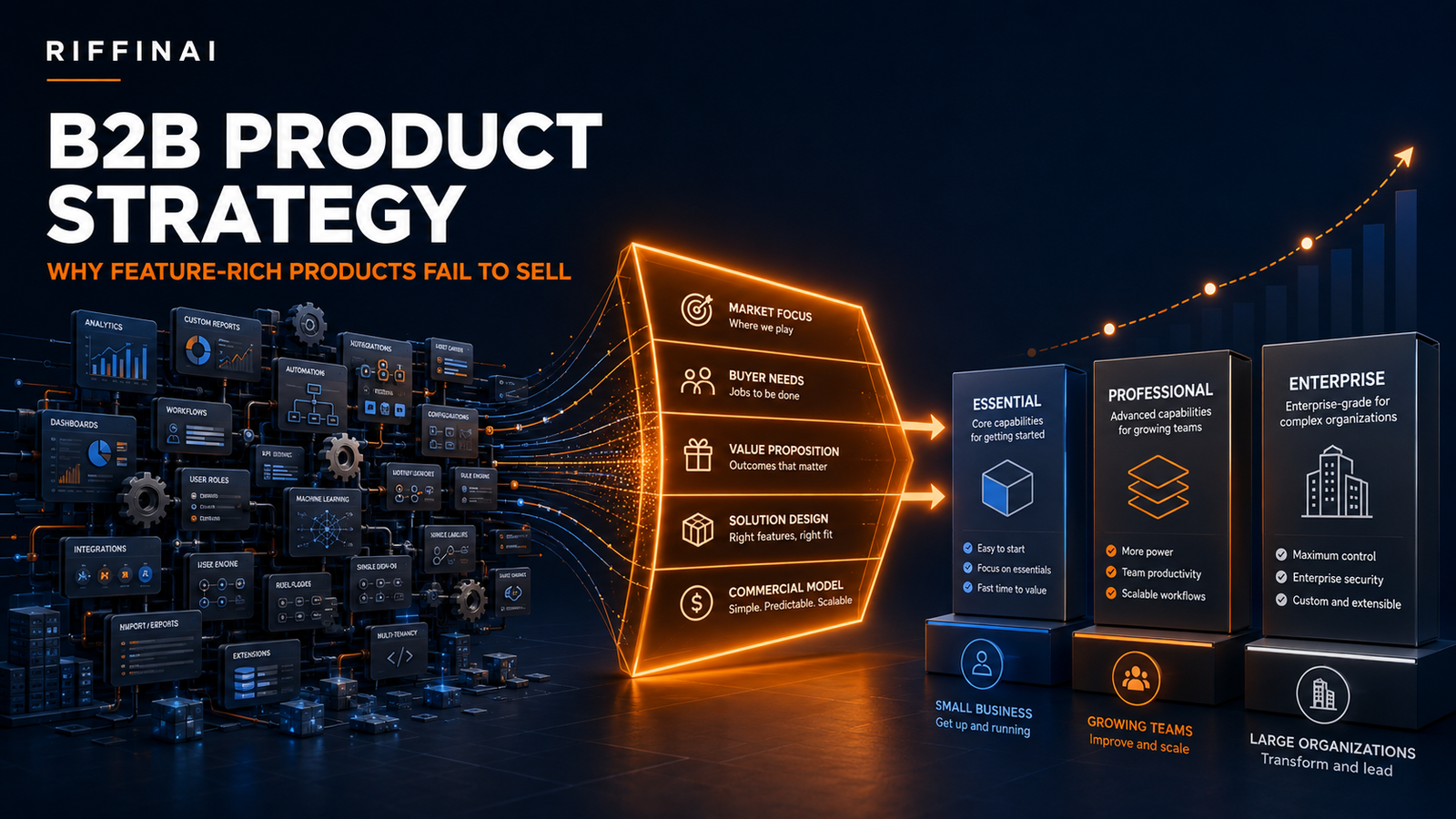

B2B Product Strategy: Why Feature-Rich Technology Products Still Fail to Sell
A technology company can spend years building an impressive product and still struggle to sell it.
The engineering may be strong. The feature list may be longer than competitors’. The team may have solved difficult technical problems. Yet prospects remain confused, sales cycles stay slow and the website fails to communicate why the product deserves attention.
This is rarely just a marketing problem.
It is often a B2B product strategy problem.
Quick answer: Feature-rich products struggle when buyers cannot quickly understand who the product is for, which problem it solves, what makes it different, which package fits their needs and why they should trust it. Strong B2B product strategy turns technical capability into a clear commercial offer that customers can understand, compare and buy.
More Features Do Not Automatically Create More Value
Product teams naturally think in capabilities.
Buyers think in outcomes, risk, cost and operational impact.
This creates a common communication gap. The company explains what the product can do, while the buyer is still trying to answer more basic questions:
- Is this designed for a company like ours?
- Which business problem does it solve first?
- How will it fit our current systems and processes?
- Which plan or configuration do we need?
- What will implementation require?
- Why should we choose it instead of a familiar alternative?
- What evidence shows that the product works?
A long feature matrix cannot answer these questions by itself.
Features become commercially valuable only when they are connected to a defined customer, use case, outcome and buying decision.
What Is B2B Product Strategy?
B2B product strategy is the set of decisions that connects a product’s capabilities with a specific market opportunity and a repeatable path to revenue.
It defines:
- The ideal customers the product should prioritize
- The problems and use cases it should own
- Its category and competitive position
- The capabilities that create meaningful differentiation
- How features should be organized into products, modules and add-ons
- How plans should be packaged and priced
- What the website, sales team and partners should communicate
- Which evidence is required to reduce buyer uncertainty
- How product success should be measured
A product roadmap explains what the team plans to build. Product strategy explains why those choices matter commercially, for whom and in what order.
Seven Reasons Strong Technology Products Remain Difficult to Sell
1. The Ideal Customer Is Too Broad
Many technology companies claim to serve startups, SMEs, enterprises, retailers, service businesses and government organizations at the same time.
The product may technically support all of them. Commercially, however, each segment has different priorities, budgets, buying committees, implementation requirements and expectations.
When every customer is treated as a priority, the website becomes generic, sales conversations become inconsistent and the roadmap becomes reactive.
A stronger strategy identifies the best initial market based on factors such as:
- Urgency of the problem
- Ability and willingness to pay
- Product readiness for the use case
- Implementation complexity
- Competitive intensity
- Sales-cycle length
- Expansion potential
- Availability of credible proof
Prioritization does not mean permanently rejecting other markets. It means creating a clear starting point from which the product can win.
2. The Category Is Unclear
Terms such as “digital ecosystem,” “intelligent solution” and “all-in-one innovation platform” may sound ambitious, but they rarely help a buyer understand what the product actually is.
A clear category gives the market a reference point. It helps prospects know which budget, problem, team and alternatives are relevant.
Creative positioning should add distinction after category clarity—not replace it.
For example:
Unclear: “An intelligent solution transforming business operations.”
Clearer: “A maintenance management system for multi-site facility teams that need to schedule preventive work, assign technicians and reduce equipment downtime.”
The second statement is not necessarily the final headline. But it gives the buyer useful information: category, audience, use case and scope.
3. Features Are Not Connected to Business Outcomes
“Real-time dashboards,” “workflow automation,” “advanced permissions” and “AI-powered insights” describe capabilities. They do not automatically explain value.
Each priority feature should be translated through a simple chain:
Capability → Use case → Operational improvement → Business outcome
For example:
| Capability | Use case | Operational improvement | Business outcome |
|---|---|---|---|
| Automated inventory alerts | Identify low stock across branches | Reduce manual monitoring and delayed replenishment | Fewer stockouts and missed sales |
| Role-based access control | Give teams access based on responsibility | Improve control without sharing unrestricted accounts | Lower operational and security risk |
| Unified customer records | Connect transactions and customer activity | Give sales and service teams a consistent view | Faster service and better retention opportunities |
This translation should guide product pages, demonstrations, proposals and sales conversations.
4. Packaging Reflects the Product Architecture, Not the Buying Journey
Internal product structures do not always match how customers want to buy.
A development team may organize capabilities by module, database or technical dependency. Buyers may instead think in business stages, company size, number of users, locations, transaction volume or operational complexity.
Good packaging answers:
- What is included in the entry plan?
- What triggers the need to upgrade?
- Which capabilities belong in higher tiers?
- Which functions should be optional add-ons?
- Are B2B, marketplace or enterprise requirements separate offers?
- Which usage limits are commercially meaningful?
- What requires implementation or customization?
If plan differences are difficult to explain, the packaging is probably reflecting internal complexity rather than customer value.
5. Pricing Has No Clear Logic
Price is not just a number. It communicates how the company understands value.
B2B technology products may charge by user, location, transaction, storefront, record volume, feature tier, implementation scope or a combination of these. The right model depends on how customers receive value and how the provider’s cost and service complexity grow.
Common pricing problems include:
- A low entry price followed by unpredictable mandatory costs
- Too many variables for buyers to estimate total cost
- Enterprise features placed in entry-level plans
- Essential features sold as confusing add-ons
- No visible reason to choose one tier over another
- Prices copied from competitors without considering product maturity or market position
- Custom pricing applied to every customer, preventing repeatability
Competitive benchmarking is useful, but it should inform pricing—not replace strategic judgment.
6. Differentiation Is Based on Claims Instead of Decisions
“Innovative,” “flexible,” “powerful” and “AI-powered” are not meaningful differentiators when every competitor uses them.
Real differentiation usually comes from deliberate choices, such as:
- Serving a specific industry or operating model
- Simplifying a complex implementation process
- Combining capabilities that customers otherwise buy separately
- Providing stronger localization for a target market
- Offering a distinct deployment, support or commercial model
- Integrating workflows competitors leave disconnected
- Building expertise around a difficult use case
If a competitor can copy the company’s main claim by changing the logo, the positioning is not yet strong enough.
7. Proof Is Missing or Disconnected
The stronger the claim, the stronger the evidence required.
Buyers need proof that reduces risk. Depending on the product and its maturity, this may include:
- Customer case studies
- Implementation examples
- Before-and-after operational results
- Security and compliance information
- Product demonstrations
- Integration documentation
- Named leadership and technical expertise
- Transparent methodology
- Customer reviews and third-party validation
- Clear product-availability status
Proof should be attached to the claim it validates. A page filled with logos does not explain which product was used, which problem was solved or what result was achieved.
The RiffinAI Product-to-Market Clarity Framework
Before investing more heavily in promotion, a B2B technology company should align seven layers.
1. Market
Choose the priority segments, industries, regions and company profiles the product is best prepared to serve.
2. Problem
Define the commercially important problems the product solves and the situations that create urgency to buy.
3. Position
Establish a recognizable category, relevant alternatives and a defensible reason the product deserves consideration.
4. Offer
Organize capabilities into clear products, editions, packages, modules and add-ons based on how customers evaluate and adopt the solution.
5. Price
Select value metrics, limits and implementation fees that buyers can understand and the business can deliver profitably.
6. Proof
Build credible evidence for the product’s priority claims, use cases and differentiation.
7. Communication
Translate the strategy consistently across the website, proposals, demonstrations, sales scripts, partner materials and digital profiles.
These layers are connected. Changing the target market may change the priority use cases. That can change packaging, pricing, proof requirements and website architecture.
This is why isolated copywriting or a visual redesign rarely fixes a deeper product-strategy problem.
A Simple Test: Can Your Team Explain the Product Consistently?
Ask product, sales, marketing and leadership team members to answer these questions separately:
- What category does the product belong to?
- Who is the ideal customer today?
- What urgent problem does the product solve?
- Which three capabilities matter most to that customer?
- Why should a buyer choose it over the main alternative?
- Which package should a typical customer start with?
- What proof supports the main promise?
- What should the customer do next?
If the answers are materially different, the market is probably receiving the same inconsistency.
Why More Marketing Spend Cannot Fix an Unclear Product
Advertising can increase attention. It cannot create strategic clarity after the click.
When the offer is unclear, additional traffic often produces:
- Low-quality leads
- Longer qualification calls
- Repeated requests for basic explanations
- Custom proposals for every prospect
- Pressure to discount
- Slow sales cycles
- Weak conversion rates
- Conflicting feedback from different customer types
This does not mean companies should stop marketing until every question is perfect. It means product strategy and go-to-market execution should improve together.
The goal is not to wait for certainty. The goal is to replace avoidable ambiguity with testable decisions.
Product Clarity Also Affects AI Visibility
The same unclear messaging that confuses buyers can make a product harder for search and AI-powered discovery systems to interpret.
ChatGPT search uses web sources and provides links to supporting content. OpenAI states that websites must allow OAI-SearchBot if they want their pages to be eligible to appear in ChatGPT search answers. Google similarly explains that structured data can provide explicit clues about the meaning of page content, while Microsoft now reports when publisher pages are cited across Copilot and Bing’s AI-generated experiences.
Technical accessibility is important, but it cannot invent a strategy the business has not expressed.
If the website does not clearly define the product category, audience, use cases, packages, relationships and proof, structured data alone will not resolve the underlying ambiguity.
This is where product strategy, product marketing, SEO and Generative Engine Optimization converge:
- Product strategy decides what the offer means
- Product marketing expresses that meaning for buyers
- SEO makes the information discoverable through search
- GEO strengthens how the company and its products are understood, cited and represented across AI-powered discovery
For a deeper explanation, read Why AI Mentions Some Brands but Recommends Others.
When Should a Company Review Its Product Strategy?
A strategic review is especially valuable when:
- The product has many features but low market understanding
- Sales depends heavily on the founder or product team
- Every proposal becomes a custom solution
- The website is being rebuilt but the navigation and message remain unclear
- Pricing is based mainly on competitor copying or internal opinion
- Multiple products overlap or compete with each other
- The team cannot agree on the ideal customer
- New markets are being considered without a clear entry strategy
- Marketing generates interest but not qualified demand
- AI tools describe the company or product inaccurately
These are not isolated communication problems. They are signals that strategic choices need to be clarified before the company scales execution.
From Technical Capability to Commercial Clarity
A great B2B product needs more than strong engineering.
It needs a market position customers can recognize, packages they can evaluate, pricing they can understand, evidence they can trust and language that connects every feature to a meaningful outcome.
The companies that achieve this clarity make more than their marketing better. They improve product prioritization, sales consistency, website structure, partner enablement and AI visibility at the same time.
The strategic question is not simply:
“How many features have we built?”
It is:
“Have we turned those capabilities into an offer the market can understand and confidently buy?”
Turn Your Product Capabilities Into a Clear Market Offer
RiffinAI helps technology companies connect product strategy with market positioning, competitive benchmarking, pricing and packaging, website communication and AI Visibility.
Our work is designed to turn complex capabilities into a clear commercial system—understood by customers and recognized by AI.
Explore RiffinAI’s strategic consulting and AI Visibility services or contact RiffinAI to discuss your product’s next stage of growth.
Frequently Asked Questions
What is B2B product strategy?
B2B product strategy defines which customers a product will prioritize, which problems it will solve, how it will compete, how capabilities will be packaged and priced, and how the company will create a repeatable path from product development to revenue.
Why do feature-rich products fail to sell?
Feature-rich products often struggle when buyers cannot quickly understand the ideal use case, business value, differences between packages, total cost, implementation requirements or reasons to trust the product. More features can increase confusion when they are not organized around customer decisions.
Is product strategy the same as product marketing?
No. Product strategy determines the market, customer, problem, position and commercial priorities. Product marketing translates those decisions into messaging, launches, sales enablement and customer-facing communication. They should be closely aligned.
How should a B2B software company package its product?
Packages should reflect meaningful differences in customer needs, value, complexity and adoption stage. A company may structure plans by capabilities, users, locations, transaction volume, business type or service level, but each tier should have a clear buyer and upgrade reason.
Should pricing be based on competitors?
Competitor pricing is a useful reference, but it should not be copied in isolation. Pricing should also reflect customer value, product maturity, market position, delivery cost, implementation complexity and the metric that grows as customers receive more value.
Can product strategy improve AI visibility?
Yes, indirectly and strategically. Clear product categories, audiences, use cases, relationships, packages and proof make the company’s digital information easier for customers, search engines and AI-powered systems to interpret. However, no strategy can guarantee recommendations from independent AI platforms.