
Online product discovery is becoming conversational.
A shopper may no longer begin with a short keyword, open ten product pages and compare every option manually. They may ask an AI system a detailed question instead:
Example question: What are the best noise-cancelling headphones under $250 for frequent travel, long battery life and comfortable all-day use?
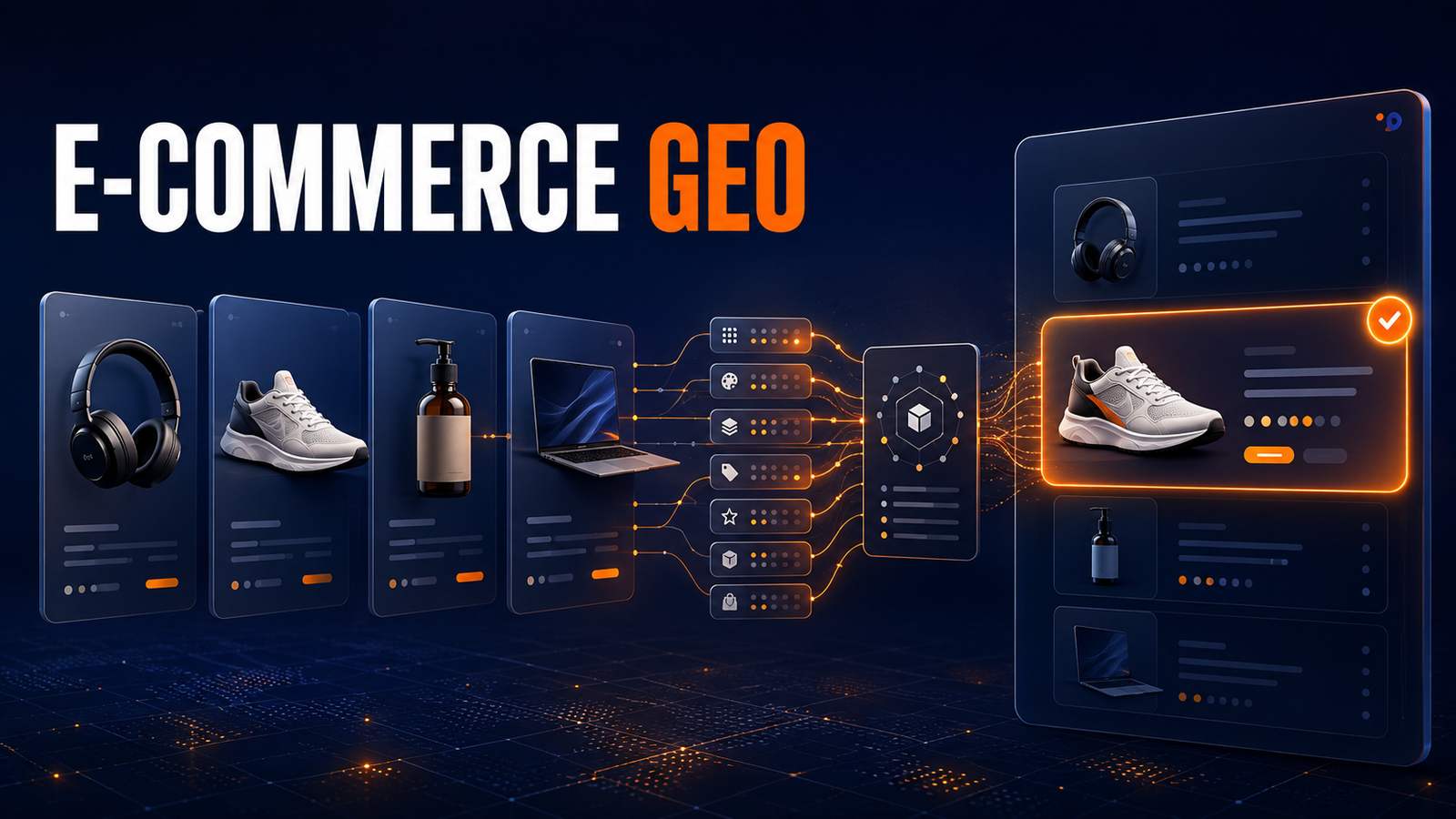
The AI system may then narrow the market, compare suitable products, explain the trade-offs and recommend a shortlist. For an e-commerce brand, the commercial question is no longer only whether a product ranks for a keyword. It is whether AI systems can find the product, understand it accurately and consider it relevant enough to include in a recommendation.
That is the challenge addressed by e-commerce GEO and RiffinAI’s AI Shopping Optimization™ framework.
What Is E-Commerce GEO?
E-commerce GEO is the application of Generative Engine Optimization to online stores, product catalogs and digital shopping journeys. It focuses on making product and brand information accessible, understandable, verifiable and useful to AI-powered search and shopping experiences.
Traditional e-commerce SEO remains essential. It helps search engines crawl, index and rank category pages, product pages and buying guides. E-commerce GEO builds on that foundation for a different discovery experience: the user receives a synthesized answer, comparison or recommendation rather than only a list of links.
The objective is not to manipulate an AI model or guarantee a recommendation. It is to remove the information gaps that prevent a legitimate product from being understood and evaluated accurately.
E-Commerce GEO and AI Shopping Optimization™
E-commerce GEO describes the broader optimization discipline. AI Shopping Optimization™ is RiffinAI’s implementation framework for turning that discipline into coordinated technical, content, product-data and authority work.
The framework asks four practical questions:
Can AI systems access the store and its important product information?
Can they distinguish each product, variant, price, availability status and intended use?
Can they find enough credible context to compare the product confidently?
Can the business measure where it appears, where competitors appear and what needs to improve?
Key principle: AI visibility measurement identifies the gap. Optimization work is what creates commercial value.
How AI Shopping Systems Obtain Product Information
There is no single universal product-discovery pipeline. Different AI systems may use web pages, search indexes, structured data, merchant feeds, public reviews, third-party sources and licensed data providers in different combinations.
Some mechanisms are already explicit. OpenAI allows eligible merchants to share structured product feeds so ChatGPT can index and display current product details such as price and availability. OpenAI also states that feeds provide merchants with greater control over how products appear, although a feed is not required for ordinary site crawling. Google similarly uses Product and Offer structured data and Merchant Center feeds to understand detailed product information.
This means effective e-commerce GEO should not depend on one tactic. It should strengthen the complete product-information environment.
The Seven Layers of E-Commerce GEO
1. Build a Crawlable Technical Foundation
Important product and category information should be available in the rendered page, connected through clear internal links and accessible without requiring an AI system to perform complex interactions. Accidental noindex directives, blocked resources, broken canonicals, redirect chains, duplicate URLs and JavaScript-only product data can all reduce discoverability.
The technical review should cover indexation, robots directives, canonicalization, pagination, faceted navigation, XML sitemaps, page performance, mobile usability and server-rendered access to essential product content.
2. Turn Product Pages Into Decision-Support Pages
A product page should do more than display a name, image and short promotional sentence. It should provide the facts needed to match the product to a buyer’s situation.
Use precise product titles that identify the brand, model and meaningful variant.
Explain who the product is for, what problem it solves and when it may not be suitable.
Provide complete specifications using consistent units and terminology.
Clarify compatibility, included components, warranty, delivery and return conditions.
Answer recurring pre-purchase questions in visible page content.
Show genuine review information and avoid unsupported superiority claims.
For example, ‘premium wireless headphones with amazing sound’ provides little comparison value. A clearer description identifies the model, form factor, active-noise-cancellation capability, battery duration, weight, supported connections, warranty and intended use. The second version gives both shoppers and machines more usable evidence.
3. Implement Product and Merchant Structured Data
Structured data converts visible product information into standardized machine-readable properties. For purchasable products, the foundation commonly includes Product and Offer markup with accurate identifiers, brand, model, description, images, price, currency, availability and condition.
Depending on the catalog, the implementation may also cover ProductGroup and variants, AggregateRating, shipping details, return policies and organization-level merchant information. The structured data must match the information visible to users; markup should never be used to insert claims that the page does not support.
Google documents that Product markup can make a page eligible for merchant-listing experiences and can communicate details such as price, availability, shipping and returns. Eligibility is not a guarantee of display, but valid markup gives search systems a clearer product record.
4. Prepare Accurate, Continuously Updated Product Feeds
A structured feed becomes especially valuable when a store has many products, frequent price changes, multiple variants or changing inventory. The feed should remain consistent with the website and backend systems.
Maintain stable product IDs and valid identifiers such as GTIN, MPN and brand where applicable.
Keep titles, descriptions, images, prices, currencies and availability current.
Represent variants consistently through item-group relationships and variant attributes.
Include shipping, returns and policy information when the destination supports it.
Monitor feed errors, disapprovals, stale values and website-to-feed conflicts.
OpenAI’s current product-feed specification supports Google-compatible product data formats. Google also warns that missing identifiers, incorrect variant data, low-quality images or conflicts between the feed and website can limit eligibility or cause incorrect product displays.
5. Create Content Around Real Buying Decisions
Product pages describe individual items. Decision-stage content helps AI systems understand how those items fit into real purchasing contexts.
Comparison pages that explain meaningful differences without hiding disadvantages.
Buying guides organized by audience, use case, budget or constraint.
Compatibility guides, size guides and setup documentation.
Category FAQs based on genuine customer questions.
Editorial content connecting products to problems, outcomes and situations.
This content should assist the buyer rather than exist only to capture keywords. A useful guide explains selection criteria, identifies trade-offs and links each recommendation to supporting product facts.
6. Strengthen Brand and Product Authority
A store cannot build product credibility entirely on its own website. AI-generated answers may also reflect information from reviews, publishers, marketplaces, manufacturer pages, professional directories, community discussions and other external sources.
The brand should therefore maintain consistent names, descriptions, product identifiers, social profiles and company information across its digital presence. Public relations, specialist reviews, partnerships, genuine customer feedback and accurate marketplace listings can provide independent corroboration.
Authority work is not about manufacturing mentions. It is about making legitimate evidence easier to verify across sources that buyers and AI systems may consult.
7. Measure Recommendations, Sources and Business Outcomes
E-commerce GEO should be measured as a changing visibility pattern, not a fixed rank. Responses can vary by model, wording, location, date and available data.
A useful measurement program can track:
Whether the brand or product appears for priority shopping questions.
Recommendation frequency across a controlled set of prompt variations.
Which competitors are recommended and the reasons given.
Which websites and product facts are cited or reflected in the answers.
Accuracy of price, availability, features and brand positioning.
AI-referred traffic, assisted conversions and qualified enquiries where measurable.
The findings should produce an implementation backlog. If a competitor is repeatedly preferred because it has clearer compatibility information, stronger third-party validation or more complete product data, the business has a specific optimization problem to solve.
A Practical E-Commerce GEO Example
Consider an online electronics retailer selling several headphone models. Its product pages contain short supplier descriptions, inconsistent model names and incomplete variant data. Prices are current on the website but delayed in external feeds. The store also has no comparison guide for travel, office work or gaming.
An e-commerce GEO program could:
Standardize product titles, identifiers, variants and specifications.
Expand each product page with verified use-case, compatibility and policy information.
Implement and validate Product, Offer and ProductGroup structured data.
Synchronize the website, inventory system and supported merchant feeds.
Publish evidence-led comparisons for high-intent buying situations.
Earn and consolidate credible external product coverage.
Test representative AI shopping questions before and after implementation.
The program does not guarantee that an AI system will recommend the retailer. It makes the retailer’s catalog more complete, consistent and usable wherever supported discovery systems obtain product information.
What E-Commerce GEO Cannot Guarantee
AI Shopping Optimization™ should be presented with realistic expectations. No agency, feed provider or schema implementation can guarantee a product recommendation across ChatGPT, Gemini, Google AI experiences, Perplexity or other systems.
Platform coverage and eligibility also vary by market. For example, OpenAI currently states that ChatGPT shopping is live in the United States and will expand to additional regions over time. Brands operating in Egypt, the GCC or other markets can still improve their technical and product-data readiness, strengthen broader AI-search visibility and verify which integrations are currently available to them.
The right promise: Make the product easier to discover, understand and evaluate—then measure whether visibility and qualified discovery improve.
E-Commerce GEO Readiness Checklist
Priority product and category pages are crawlable, indexable and internally linked.
Product names, identifiers, variants and specifications are consistent across systems.
Prices, availability, currency, shipping and return information are accurate.
Product, Offer and relevant variant structured data are valid and match visible content.
Merchant feeds are complete, synchronized and monitored where available.
Product pages answer the questions buyers ask before purchasing.
Comparison and buying-guide content explains genuine trade-offs.
Brand and product information is consistent across credible external sources.
Priority AI shopping prompts are tested through a repeatable measurement method.
Findings are translated into technical, content, data and authority actions.
How RiffinAI Approaches AI Shopping Optimization™
RiffinAI does not stop at producing an AI visibility score. Measurement is the diagnosis; implementation is the service.
Our AI Shopping Optimization™ approach can combine:
E-commerce AI visibility and competitor analysis.
Technical crawling and indexation review.
Product-page and category-content optimization.
Product, Offer, variant and merchant-policy schema implementation.
Product-feed readiness and consistency review.
Buying-guide, comparison and question-led content strategy.
Entity, citation and external authority development.
Ongoing testing, measurement and optimization prioritization.
The exact scope depends on the commerce platform, catalog structure, target markets and available integrations. The objective remains consistent: help AI systems understand the business and its products accurately enough to consider them in relevant discovery and recommendation journeys.
Conclusion
E-commerce competition is expanding beyond search rankings and marketplace positions. As shoppers use AI systems to research, compare and narrow product choices, online stores need a product-information environment designed for both people and machines.
That requires more than adding schema or publishing another blog post. It requires coordinated work across crawlability, product data, page content, structured feeds, buyer education, external authority and measurement.
The brands that prepare early will not be guaranteed a recommendation. They will, however, be easier to understand, verify and evaluate when AI systems help customers decide what to buy.
Ready to assess your store? Contact RiffinAI to evaluate how clearly AI systems can discover, understand and represent your products—and what should be optimized next.
Frequently Asked Questions
Is e-commerce GEO the same as e-commerce SEO?
No. E-commerce SEO focuses primarily on visibility in conventional search results. E-commerce GEO builds on that foundation to improve how products and brands are understood and represented in AI-generated answers, comparisons and shopping experiences. A strong strategy normally needs both.
Does Product schema guarantee that AI will recommend a product?
No. Structured data helps machines interpret product information, but it does not guarantee indexing, display or recommendation. Product quality, relevance, availability, evidence, external authority and platform-specific systems can also influence what appears.
Does every online store need a direct product feed to ChatGPT?
No. OpenAI states that a feed is not required when ChatGPT can crawl a site, but feeds can give merchants greater control over the accuracy and freshness of product information. Direct feed access and shopping availability may also vary by merchant and region.
Can stores in Egypt and the GCC benefit from e-commerce GEO?
Yes, although individual shopping features and merchant integrations differ by market. Stores can improve crawlability, structured data, product content, feed readiness, entity clarity and broader AI-search visibility while monitoring regional platform availability.
How is e-commerce GEO performance measured?
Measurement can include recommendation frequency for controlled shopping prompts, competitor visibility, source and citation patterns, factual accuracy, AI-referred visits, assisted conversions and qualified enquiries. Because AI responses vary, repeated testing is more useful than treating one answer as a permanent rank.
How long does e-commerce GEO take to produce results?
There is no universal timeline. Technical fixes may be implemented quickly, while crawling, feed processing, content discovery, authority development and platform updates can take longer. A realistic program establishes a baseline, prioritizes high-impact gaps and measures changes over time.