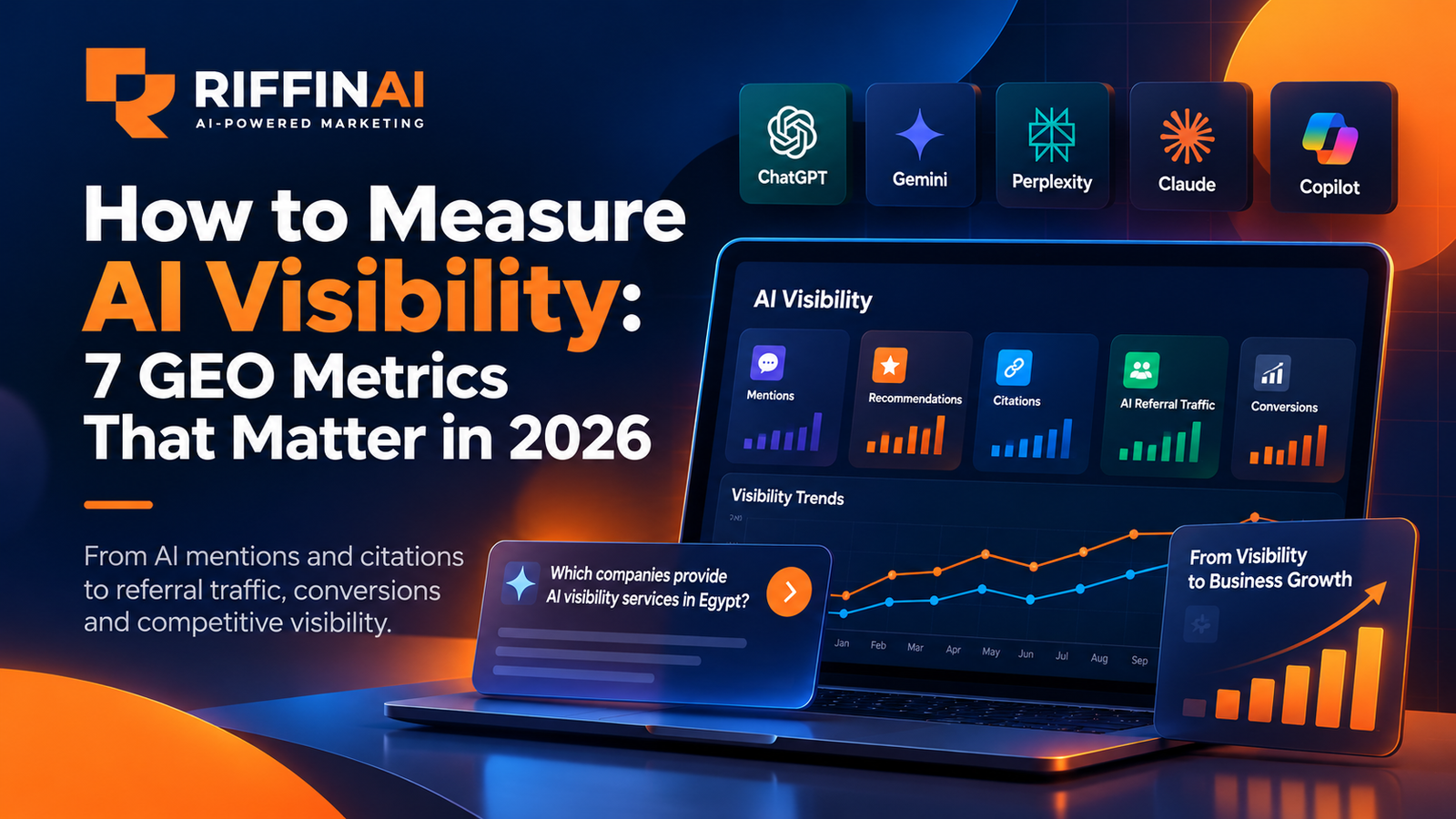

How to measure AI visibility is becoming an important question for businesses investing in ChatGPT, AI search and Generative Engine Optimization (GEO).
Traditional SEO already gives marketers familiar measurements: rankings, impressions, clicks, organic traffic and conversions.
That question is becoming increasingly important as companies invest in Generative Engine Optimization (GEO), AI search optimization and content designed for AI-powered discovery.
Traditional SEO already gives marketers familiar measurements: rankings, impressions, clicks, organic traffic and conversions.
AI visibility is different.
There is no single universal “AI ranking” that tells you where your company stands across ChatGPT, Gemini, Perplexity, Claude, Copilot and other AI experiences.
A brand might be mentioned for one question but absent from another. It might be cited as a source without being recommended as a provider. An AI-generated answer may also change according to the wording of the question, platform, context, location and time.
That means measuring AI visibility requires a combination of metrics rather than one score.
For business owners and marketing leaders, seven measurements are particularly useful.
Quick Answer: How Do You Measure AI Visibility?
AI visibility can be measured by tracking your brand across a consistent set of commercially relevant AI queries and monitoring seven areas:
- AI mentions
- Recommendation visibility
- Citation and source visibility
- Prompt and topic coverage
- Competitive visibility
- AI referral traffic
- Leads and conversions from AI discovery
The objective is not simply to make a chart go up.
The objective is to understand whether your business is becoming easier to discover, understand and consider when potential customers use AI to research their options.
Why AI Visibility Measurement Is Different From SEO Measurement
In conventional SEO, Google Search Console can show which queries generated impressions, clicks, click-through rates and average positions.
That gives marketers a relatively standardized measurement environment.
AI discovery is more fragmented.
A customer could ask:
“Which companies provide GEO services in Egypt?”
Another could ask:
“Who can help my company appear in ChatGPT?”
And another:
“Compare AI visibility agencies for a growing business in Cairo.”
Those questions may express similar commercial intent without using the same wording.
Different AI platforms may also generate different answers.
This is why measuring AI visibility by manually asking ChatGPT one question once is not enough.
You need a repeatable baseline.
Metric 1: Relevant AI Mentions
The first measurement is straightforward:
Does the AI platform mention your business when answering relevant questions?
But the word “relevant” matters.
A company mentioning itself by name is different from appearing when a potential customer asks about a category, problem or service.
For example, a GEO agency could monitor questions around:
- GEO agencies;
- AI visibility services;
- AI search optimization;
- appearing in ChatGPT;
- improving brand visibility in AI;
- and related commercial problems.
The goal is not to create hundreds of random prompts.
Start with a controlled group of questions representing how real customers research your category.
Then record whether the company appears.
Over time, this creates a more useful visibility baseline than an isolated screenshot.
What to record
For each test, record:
- platform;
- question;
- date;
- whether the brand appeared;
- how the brand was described;
- and whether the answer was relevant to the intended query.
This allows you to measure patterns instead of anecdotes.
Metric 2: Recommendation Visibility
A mention and a recommendation are not the same thing.
An AI platform may know that your company exists without presenting it when someone asks for providers to consider.
That distinction is commercially important.
Consider these two questions:
“What is RiffinAI?”
and
“Which companies provide AI visibility services in Egypt?”
The first tests brand recognition.
The second tests category or recommendation visibility.
Businesses should monitor both.
For commercial GEO programs, recommendation visibility can be particularly useful because it is closer to the customer’s consideration stage.
However, it needs to be interpreted carefully.
AI recommendations are dynamic. No legitimate agency can guarantee that an independent AI platform will recommend a particular business for every user or every query.
The useful measurement is whether recommendation visibility is improving across a consistent test set over time.
Metric 3: Citation and Source Visibility
AI visibility is not limited to whether the company name appears.
Another important question is:
Is your website being used or surfaced as a source?
Some AI search experiences provide citations or source links that allow users to investigate the information behind an answer.
A business can therefore have source visibility even when the answer is not explicitly recommending the company itself.
This matters for publishers, research-driven businesses and companies building expertise around important commercial topics.
For example, a RiffinAI article explaining AI visibility could potentially be useful as a source for a question about GEO even if the answer is not recommending RiffinAI as an agency.
What to monitor
Track:
- which URLs are being cited;
- which topics generate citations;
- which AI platforms surface those pages;
- whether citations remain consistent over time;
- and whether cited pages subsequently receive referral traffic.
This can also reveal which pieces of content are becoming particularly useful within AI-powered discovery.
Metric 4: Prompt and Topic Coverage
One successful AI answer can be encouraging.
It does not mean you have broad AI visibility.
A better question is:
Across the topics that matter commercially, how much of the relevant discovery landscape does your brand cover?
Imagine that you monitor 20 carefully selected questions.
Your company might appear in:
- 8 of 20 questions on ChatGPT;
- 5 of 20 on another platform;
- and 11 of 20 on a third.
Those numbers create a baseline.
You can then repeat the same test set periodically and look for directional change.
This is much more useful than continually changing the questions until you receive the answer you want.
Build prompts around business intent
A useful test set might contain several types of questions:
Category questions
“What companies provide [service]?”
Problem questions
“Who can help a business solve [problem]?”
Comparison questions
“What are the differences between providers of [service]?”
Location questions
“Which companies provide [service] in [market]?”
Educational questions
“How does [topic] work?”
This creates a more balanced view of AI visibility across the customer’s research journey.
Metric 5: Competitive AI Visibility
Your own visibility number becomes more useful when you understand what else is appearing.
If your company does not appear for an important question, which companies do?
If the same competitor repeatedly appears across relevant questions and platforms, that is useful strategic information.
Competitive AI visibility analysis can help identify:
- competitors frequently surfaced by AI;
- categories where your company is absent;
- areas where your positioning may be unclear;
- content gaps;
- and questions where competitors have stronger visibility.
The objective is not to copy everything competitors do.
It is to understand the AI discovery landscape around your market.
This can inform decisions about content, positioning, website structure and future GEO priorities.
Metric 6: AI Referral Traffic
This is where AI visibility starts becoming much more tangible.
If an AI platform sends someone to your website, that visit can potentially be measured in analytics.
For ChatGPT specifically, OpenAI states that publishers allowing its search crawler to access their content can track ChatGPT referral traffic through analytics platforms such as Google Analytics.
That gives businesses an important bridge between AI visibility and website performance.
Instead of only asking:
“Did ChatGPT mention us?”
you can also ask:
“Did somebody actually visit our website from ChatGPT?”
What to analyze
In your analytics platform, look at:
- sessions from AI platforms;
- landing pages receiving AI referrals;
- engagement from those visitors;
- geography;
- enquiries or events;
- and changes over time.
Also pay attention to the pages receiving the traffic.
If a particular guide consistently attracts AI-referred visitors, that is a useful signal about the questions and topics where your content is gaining visibility.
Metric 7: Leads and Conversions From AI Discovery
Traffic is useful.
Business outcomes matter more.
A GEO program should eventually move beyond measuring mentions and visits toward understanding whether AI discovery contributes to:
- contact enquiries;
- booked calls;
- quote requests;
- registrations;
- purchases;
- qualified leads;
- or other meaningful conversions.
Attribution will not always be perfect.
Someone could discover your company in ChatGPT, search for the brand on Google later and then submit a form.
That conversion might appear as organic search or direct traffic rather than an AI referral.
This is why AI visibility reporting should combine quantitative analytics with other evidence where appropriate.
For lead-generation businesses, one simple addition can help:
Ask prospects how they heard about you.
If customers begin saying:
“ChatGPT recommended you.”
that information is commercially significant even when the analytics journey does not show a clean AI referral path.
Don’t Reduce GEO to a Single AI Visibility Score
AI visibility scores can be useful.
They provide a simple baseline and can make complicated data easier for leadership teams to understand.
But a score should be treated as a summary indicator, not the entire measurement system.
A company could improve its score while attracting no qualified traffic.
Another could have relatively limited overall visibility but appear consistently for a small number of highly commercial questions that generate enquiries.
Which business is performing better?
The answer depends on the business objective.
That is why RiffinAI looks beyond visibility alone.
The more useful progression is:
Visibility → Relevance → Traffic → Engagement → Conversion
The closer measurement gets to commercial outcomes, the more useful it becomes for decision-makers.
How Often Should You Measure GEO Performance?
AI answers can vary.
Checking every few minutes will usually create noise rather than insight.
For most businesses, the better approach is to establish a stable testing methodology and repeat it at sensible intervals.
For example:
- maintain a consistent core prompt set;
- test the same platforms;
- record dates;
- preserve results;
- monitor AI referral traffic continuously;
- and review broader trends periodically.
The exact frequency should depend on the size of the program and how quickly the underlying website and content are changing.
What matters most is consistency.
If you change the prompts, platforms and methodology every reporting period, comparisons become much less meaningful.
What Does a Useful GEO Report Look Like?
A business-focused GEO report should answer more than:
“Our AI visibility score increased.”
Leadership teams should be able to understand:
Where are we appearing?
For which commercially relevant questions?
How accurately are we being represented?
Which competitors are appearing when we don’t?
Which pages are receiving AI referrals?
Are those visitors engaging?
Are we seeing enquiries or conversions associated with AI discovery?
That moves GEO reporting away from vanity metrics and toward decision-making.
Measuring ChatGPT Referral Traffic
ChatGPT is particularly interesting because referral measurement has become more practical.
OpenAI explains that websites can appear in ChatGPT search when eligible content is accessible to its search crawler. OpenAI also says ChatGPT search referral URLs include utm_source=chatgpt.com, which enables publishers to analyze incoming traffic using tools such as Google Analytics.
That means businesses should make AI referral traffic part of their analytics reviews rather than treating AI visibility entirely as an off-site phenomenon.
If ChatGPT is sending visitors to your website, examine:
- where they land;
- what content attracted them;
- what they do next;
- and whether they convert.
Those insights can help connect GEO strategy with the rest of the customer acquisition system.
AI Visibility Should Be Measured Against Business Priorities
Not every company needs visibility for thousands of questions.
A specialized B2B company may care about a relatively small set of high-value buying situations.
An e-commerce company may need much broader product and category coverage.
A local business may care most about location-specific recommendations.
An international company may need to measure visibility across markets and languages.
The measurement framework should therefore reflect the business.
Start with questions such as:
Which products or services generate the most value?
Which markets matter?
What questions do customers ask before contacting us?
Which competitors are genuinely relevant?
Which actions on the website represent commercial value?
Then build the GEO measurement framework around those priorities.
From AI Visibility to Business Growth
The purpose of GEO is not to win screenshots.
It is to improve discoverability as customer behavior evolves.
A business can celebrate appearing in ChatGPT, but the more important questions come next:
Did the right audience discover the company?
Was the business represented accurately?
Did the user visit the website?
Did they engage with the business?
Did that visibility contribute to a commercial outcome?
That is the measurement journey businesses should be building.
AI mention → Relevant visibility → Referral → Engagement → Lead → Revenue
Not every journey will follow that exact sequence, and not every stage will always be measurable.
But it provides a much stronger business framework than simply asking whether a brand appeared in one AI response.
How RiffinAI Measures AI Visibility
RiffinAI approaches GEO measurement as part of a broader AI visibility and growth system.
We look at how businesses are discovered and represented across relevant AI-powered environments, establish baselines around commercially meaningful questions, identify visibility gaps and connect those findings with measurable website and business signals where possible.
This can include:
- AI visibility benchmarking;
- brand and service recognition;
- prompt and topic coverage;
- competitive visibility;
- citation and source analysis;
- AI referral traffic;
- analytics;
- and conversion signals.
The objective is not to promise a permanent ranking inside an AI platform.
It is to build a clearer picture of where your business is visible, where it isn’t, what is changing and whether that visibility is contributing to growth.
Start With an AI Visibility Baseline
You cannot measure improvement without knowing where you started.
Before investing heavily in GEO, establish a baseline.
Identify the questions that matter.
Test relevant AI platforms.
Document your current visibility.
Review how your company is described.
Check whether competitors appear where you do not.
Measure existing AI referral traffic.
Then optimize and compare the results over time.
RiffinAI’s AI Visibility Audit provides a starting point for businesses that want to understand how they currently appear across AI-powered discovery environments.
The goal isn’t simply to be mentioned by AI.
It’s to become discoverable in the right contexts—and turn that discovery into measurable business opportunity.
Frequently Asked Questions
What are AI visibility metrics?
AI visibility metrics are measurements used to evaluate how frequently and accurately a brand appears across AI-powered search and answer experiences. They can include mentions, recommendations, citations, prompt coverage, competitive visibility, referral traffic and conversions.
How do I measure whether my company appears in ChatGPT?
Create a consistent set of questions relevant to your products, services and market. Test them periodically, record whether the company appears and track how it is represented. Combine this with ChatGPT referral data in your analytics where available.
Can Google Analytics track traffic from ChatGPT?
Yes. ChatGPT can send measurable referral traffic to websites. OpenAI states that ChatGPT search referral URLs include tracking information that enables publishers to analyze this traffic through analytics platforms such as Google Analytics.
What is a GEO visibility score?
A GEO or AI visibility score summarizes performance across a defined testing methodology. It can be useful as a baseline, but should not replace deeper measurements such as recommendation visibility, citations, referral traffic and business conversions.
Is an AI mention the same as an AI recommendation?
No. A brand can be recognized or mentioned without being recommended when a user asks for providers, products or solutions. Measuring the distinction provides a better understanding of commercial AI visibility.
Can an agency guarantee my company will rank in ChatGPT?
No credible provider can guarantee permanent inclusion or recommendation in independently generated AI answers. AI outputs can change according to the query, platform, context, available information and time.
How long does GEO take to show results?
There is no universal timeline. Results depend on the business’s starting point, technical accessibility, existing content, market, competition and the changes being implemented. Establishing a baseline and measuring consistently is more useful than promising a fixed timeline.