
get your business found in chatgpt.
Learning how to get your business found in chatgpt and Google Gemini is undergoing the most disruptive shift since the invention of the search engine…
Every single day, millions of business owners, decision-makers, and high-value buyers are bypassing the standard Google results page. Instead, they are turning to conversational AI models, asking highly specific questions:
- “Which digital growth agency specializes in custom B2B AI agents?”
- “What is the most reliable customer support automation setup for a Shopify store?”
- “Who is the top corporate tax consultant near me?”
When an AI model answers those questions, it recommends a select few businesses. It synthesizes their data, highlights their strengths, and provides a direct citation.
If your business isn’t one of them, you are completely invisible to a massive wave of intentional buyers.
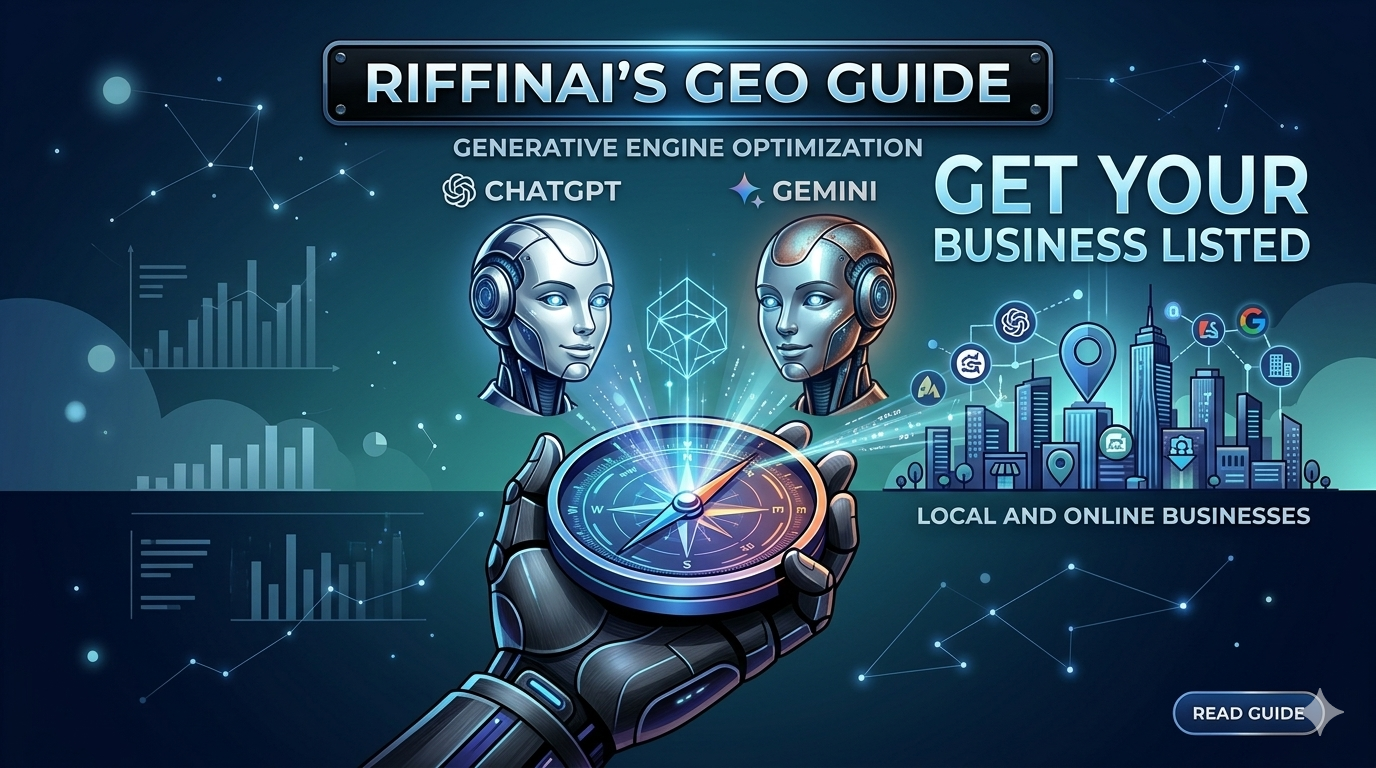
Getting your business found in ChatGPT, Google Gemini, and Claude requires a new framework: Generative Engine Optimization (GEO). Here is exactly how to build an AI-readable footprint that ensures your brand gets listed, cited, and recommended.
Why You Aren’t Appearing in ChatGPT or Gemini
If you want to know how to get your business found in chatgpt, you first have to understand…
Before you can fix your AI visibility, you need to understand how these models think.
You cannot log into an “AI Dashboard” and submit a sitemap to ChatGPT. There is no manual registration form. Large Language Models (LLMs) construct their recommendations based on two primary mechanisms:
- The Pre-training Dataset: The foundational knowledge base the AI was trained on, consisting of massive crawls of the web, books, scientific journals, and public forums.
- RAG (Retrieval-Augmented Generation): The real-time web browsing function. When you ask ChatGPT a real-time question, it uses Bing to browse the live web, pull relevant sources, and synthesize an answer. When you ask Gemini, it uses Google Search grounding to do the exact same thing.
If the AI isn’t recommending your business, it means your digital presence lacks AI-Readable Authority. The models either don’t know your entity exists, or they don’t find enough cross-referenced validation across the web to confidently recommend you to a user.
Step-by-Step: How to Get Listed and Found in AI Models
To move your brand from the shadows into the direct answers of conversational engines, execute this three-part GEO framework.
1. Build an Unshakeable Entity Footprint
AI models do not look at websites as just collections of keywords; they look at the web as a network of Entities (people, places, concepts, and organizations) and the relationships between them.
- Hardcode Your Schema Data: Ensure your website uses highly detailed Organization, Product, and Author schema. This structured data acts as an explicit translator for AI crawlers, defining exactly who you are, what you sell, and who operates the business.
- Establish Neutral Database Grounding: LLMs place an incredibly high trust weight on open, structured, and strictly moderated databases like Wikidata. Establishing a verifiable, accurate entity footprint on Wikidata gives AI models a primary source of truth to anchor your brand’s facts (such as industry, founder, and location).
- Consistent NAP (Name, Address, Phone): Ensure your digital footprint is perfectly identical across Google Business Profile, LinkedIn, Crunchbase, and major directories. Discrepancies create optimization friction for the AI.
2. Optimize for Conversational Intent and Context
Traditional SEO relies on matching rigid keyword strings like “b2b marketing agency.” GEO relies on context, sentiment, and comparative authority.
- Write for the Long-Tail: Look at your search analytics. People are asking conversational engines, “How to get your business found in chatgpt or google gemini.” Structure your content to explicitly state and answer these exact phrases.
- Incorporate Authoritative Content Depths: AI search models prefer content that contains statistical evidence, clear frameworks, quotation from industry experts, and direct solutions. Fluffy, repetitive content gets ignored by modern RAG pipelines.
- Optimize for “Brand + Versus” Queries: Users frequently ask AI to compare solutions (e.g., “Should I hire Agency X or Agency Y for digital growth?”). Create comparison pages, deep case studies, and transparent breakdown articles on your site so the AI can easily extract data when compiling comparative answers.
3. Feed the RAG Pipelines with Digital PR
Because ChatGPT and Gemini pull from live search results to answer current queries, your off-site reputation matters just as much as your on-site SEO.
- Secure Third-Party Citations: If an AI model searches the web to find the “best digital strategists in New Cairo,” it looks at lists, forum discussions, local publications, and industry blogs. You need your brand mentioned in those third-party nodes.
- Foster Independent Reviews: High-authority review platforms (Trustpilot, G2, Google Reviews) are heavily scraped and summarized by AI engines to determine customer sentiment. If your sentiment score across the web is mixed or non-existent, the AI will bypass you for a competitor with cleaner sentiment data.
Stop Guessing. Audit Your AI Visibility.
The digital landscape has fundamentally shifted. You can no longer rely solely on tracking whether you rank blue-link #1 on a traditional search page. You need to know if you are winning the AI share of voice.
Understanding your AI visibility requires a data-backed approach. By systematically analyzing how prominent LLMs interpret your brand, track your keywords, and cite your solutions, you can find the exact gaps in your entity authority.
Don’t wait for your organic traffic to dry up as conversational search takes over. Take control of your Generative Engine Optimization, build a dominant AI footprint, and ensure that when your ideal client asks an LLM for a solution, your name is the only logical answer it provides.
Frequently Asked Questions
Can you manually submit a business to get listed in ChatGPT?
No, there is no manual submission platform or index registry for ChatGPT or Gemini. To get listed, you must optimize your brand’s digital entity footprint, maintain strong structured schema on your website, and ensure your business is frequently and positively cited across authoritative third-party platforms that LLM crawlers utilize.
What is Generative Engine Optimization (GEO)?
Generative Engine Optimization (GEO) is the next evolution of search engine optimization. It focuses on optimizing content and digital entity structures so that a business is accurately indexed, understood, and recommended by AI-driven discovery engines and large language models like ChatGPT, Google Gemini, and Claude.
How does Google Gemini find information about local businesses?
Google Gemini integrates directly with Google’s real-time search index and ecosystem, including Google Maps and Google Business Profiles. To ensure Gemini surfaces your business for local or operational queries, you must maintain a highly optimized, active, and reviewed Google Business Profile alongside consistent schema markup on your main website.
By Tarek Samir