
The way people discover businesses online is changing.
For years, digital acquisition largely revolved around Google Search, social media platforms and traditional display advertising. Today, consumers are increasingly using AI platforms such as ChatGPT to research products, compare companies, evaluate services and make decisions.
Now there is another important development: advertising inside ChatGPT.
ChatGPT Ads creates a new paid acquisition channel for businesses. But it also raises an important question:
If businesses can pay to advertise in ChatGPT, what happens to organic AI visibility?
The answer is that these are two different opportunities.
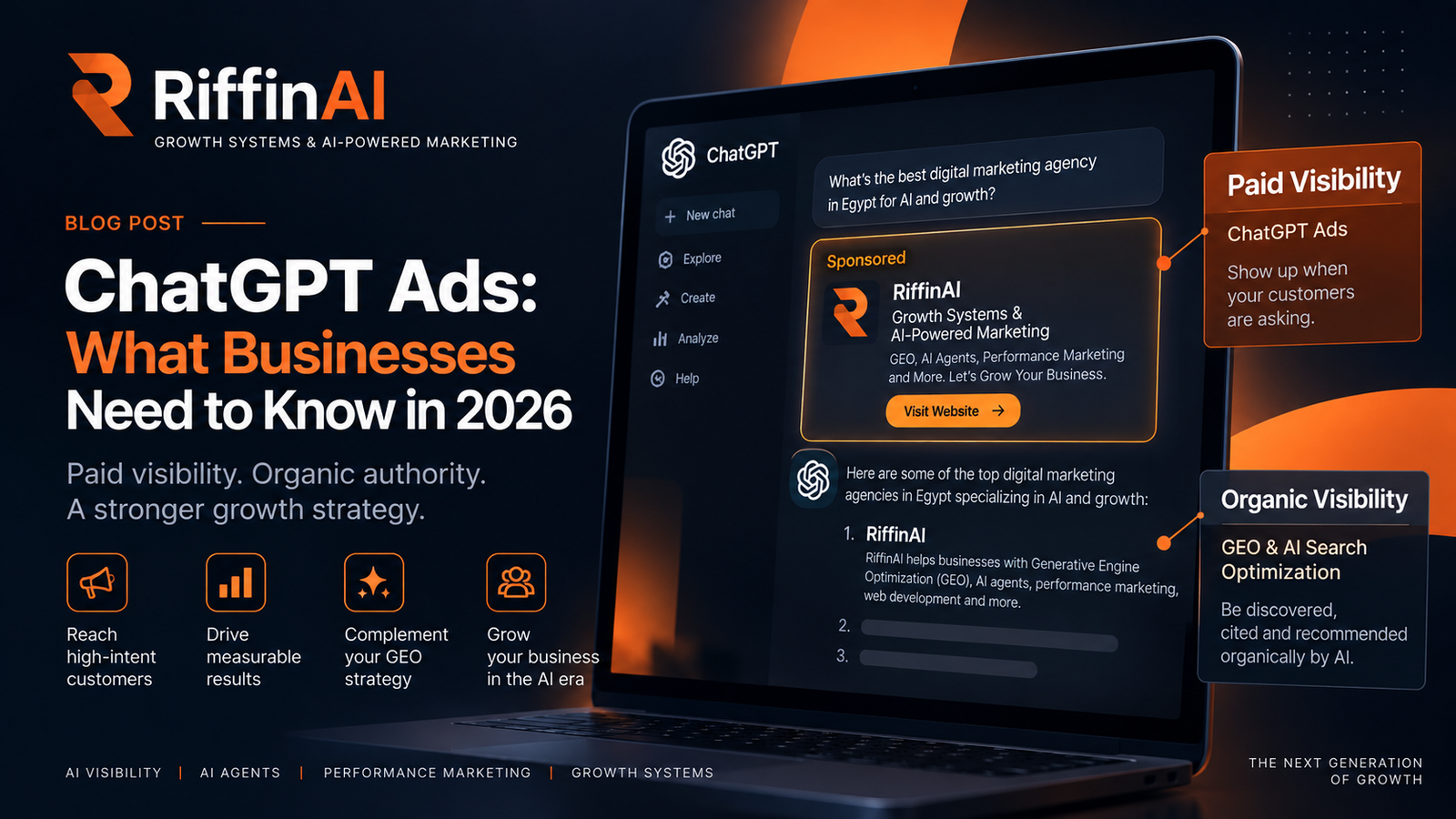
ChatGPT Ads provides paid visibility, while Generative Engine Optimization (GEO) and AI search optimization focus on improving a brand’s organic visibility and understanding within AI platforms.
Businesses should understand both.
What Are ChatGPT Ads?
ChatGPT Ads are sponsored placements that can appear within the ChatGPT experience when an advertisement is relevant to what a user is discussing or trying to accomplish.
Unlike conventional search advertising, where advertisers primarily think about individual search queries and keywords, ChatGPT operates within conversations.
A person might ask ChatGPT to:
- compare different business solutions;
- research products before buying;
- find a service provider;
- evaluate alternatives;
- plan a trip;
- investigate software;
- or decide what company might solve a particular problem.
This creates advertising opportunities around context and intent, rather than relying solely on traditional keyword matching.
OpenAI explains that its advertising system can consider signals including the context and intent of the current conversation, an advertiser’s landing page, ad title and copy, advertiser-provided context hints and other eligible relevance signals.
For marketers, this represents an important shift from simply targeting what somebody typed toward understanding what somebody is actually trying to accomplish.
How Do ChatGPT Ads Work?
Businesses using ChatGPT Ads can create campaigns through OpenAI’s Ads Manager.
Depending on the campaign objective and available features, advertisers can set campaign budgets, create ad groups, upload advertisements, choose targeting parameters and measure performance.
OpenAI currently supports advertising models including cost per click (CPC) and cost per thousand impressions (CPM).
Campaign reporting can include metrics such as:
- impressions;
- clicks;
- advertising spend;
- click-through rate;
- average CPC;
- average CPM;
- and conversions.
OpenAI has also introduced conversion measurement, allowing advertisers to measure actions that happen after someone interacts with an advertisement, such as a lead submission, registration or purchase.
This means ChatGPT is developing into a measurable advertising channel rather than simply being an experimental sponsored-placement format.
ChatGPT Advertising Is Different From Traditional Search Advertising
One of the most important differences is how intent is expressed.
Google users often express intent through relatively short searches.
A ChatGPT conversation can contain significantly more context.
Someone researching a marketing agency, for example, could explain their industry, market, objectives, current challenges, budget considerations and the results they want.
That conversational context can potentially create much richer relevance signals for advertising.
OpenAI specifically advises advertisers that ChatGPT advertising requires a different approach from traditional keyword-based advertising.
Instead of relying entirely on exact keyword matching, advertisers need to think about the conversations in which their offering would genuinely be useful.
That changes the advertising question from:
“Which keyword should we bid on?”
to:
“During which customer conversations should our business be relevant?”
Do ChatGPT Ads Influence ChatGPT’s Answers?
No.
This distinction is extremely important.
OpenAI states that advertising does not influence the answers ChatGPT provides. Sponsored advertisements are separate from ChatGPT’s organic responses and are clearly identified as advertising.
Paying for a ChatGPT advertisement therefore does not mean a company can pay ChatGPT to recommend it organically.
It also means businesses should not treat advertising as a replacement for organic AI visibility.
That brings us to GEO.
ChatGPT Ads vs GEO: What’s the Difference?
ChatGPT Ads and Generative Engine Optimization solve different visibility problems.
ChatGPT Ads are paid visibility.
A business pays for eligible sponsored placements and advertising exposure.
GEO focuses on organic AI visibility.
Generative Engine Optimization works on helping AI systems better discover, understand, contextualize and potentially cite or recommend a business when relevant.
GEO can involve areas such as:
- entity clarity;
- authoritative content;
- structured data;
- technical accessibility;
- third-party citations and authority signals;
- clear product and service information;
- consistent brand information;
- and content designed around the questions customers actually ask AI systems.
One cannot simply replace the other.
A company could advertise in ChatGPT while still having weak organic AI visibility.
Similarly, a company could have strong organic visibility while choosing not to run paid advertising.
The strongest strategy may therefore be to think about paid AI acquisition and organic AI visibility as complementary channels.
Paid AI Visibility + Organic AI Visibility
This is where the opportunity becomes particularly interesting for businesses.
Traditional search marketing eventually developed two major disciplines:
Paid Search + SEO
AI discovery appears to be developing a similar distinction:
Paid AI Advertising + Organic AI Visibility
But the mechanics are different.
Businesses now need to consider how they appear when someone encounters a sponsored placement and how their brand is represented when an AI platform independently answers questions about their category.
Imagine a potential customer asking ChatGPT about solutions in your industry.
There are potentially two valuable outcomes.
Your company might appear through an eligible sponsored advertisement.
Or your company might be surfaced, cited or understood through the organic AI answer ecosystem.
Those are different forms of visibility, and sophisticated AI marketing strategies should account for both.
RiffinAI Is Working With ChatGPT Ads
At RiffinAI, we are actively working with ChatGPT Ads as part of our broader approach to AI visibility and AI-powered customer acquisition.
Our interest isn’t limited to simply placing advertisements inside a new platform.
We are examining ChatGPT Ads alongside the wider transformation taking place in customer discovery.
RiffinAI’s work already focuses on Generative Engine Optimization (GEO), AI search optimization, performance marketing, conversion optimization and AI-powered growth systems.
ChatGPT Ads adds a paid layer to that ecosystem.
This allows us to look at the customer journey from two perspectives:
Can the right audience discover the business through paid AI advertising?
And:
Can AI platforms organically understand and surface the business when users ask relevant questions?
These questions require different optimization strategies.
What RiffinAI Is Learning From ChatGPT Ads
One of the most important early lessons is that AI advertising should not simply copy the playbook businesses use for Google or social media advertising.
Conversational environments are different.
Ad relevance depends heavily on clearly communicating what the business does, who it helps and why its offering matters.
That means landing-page quality, positioning and contextual relevance become particularly important.
Businesses should also think beyond clicks.
If somebody discovers a company through ChatGPT and then begins researching that company through AI, the strength of the company’s broader digital presence becomes part of the customer journey.
This creates a connection between:
Advertising → Landing Page → Brand Research → AI Visibility → Conversion
For RiffinAI, this is why ChatGPT Ads fits naturally within a broader growth-system strategy rather than being treated as an isolated advertising platform.
Should Your Business Advertise on ChatGPT?
ChatGPT Ads will not automatically make sense for every company.
Businesses should first consider whether their potential customers use AI during research and decision-making.
It may be particularly interesting for companies operating in markets where customers need to:
- compare alternatives;
- research complex purchases;
- evaluate service providers;
- investigate products;
- understand unfamiliar solutions;
- or make considered business decisions.
The quality of the landing page also matters.
Paying for traffic without a clear value proposition, strong user experience and effective conversion path can waste advertising budget regardless of which advertising platform generates the visitor.
Should Businesses Stop Investing in SEO or GEO?
No.
The arrival of ChatGPT Ads does not eliminate organic visibility.
In fact, OpenAI’s explicit separation between advertising and ChatGPT’s answers makes that distinction clearer.
Advertising can buy sponsored exposure.
It cannot buy an organic recommendation inside ChatGPT’s answer.
Businesses therefore need to think about multiple layers of discoverability:
Google visibility.
AI visibility.
Paid advertising.
Brand authority.
Conversion experience.
The objective isn’t to chase every new platform independently. It is to build a connected acquisition system where these channels reinforce one another.
The Future of Search May Be Paid + Organic + Conversational
Search marketing has always evolved with user behavior.
The rise of conversational AI represents another major shift.
People increasingly expect to describe what they need, provide context, ask follow-up questions and receive synthesized recommendations rather than navigate through pages of traditional search results.
Advertising is now entering that environment.
For businesses, the question is no longer simply:
“Are we ranking on Google?”
It is becoming:
“Can customers discover us wherever they search, ask, compare and make decisions?”
That includes conventional search engines, AI answer engines and increasingly paid placements inside AI platforms.
Build Your AI Visibility Strategy
RiffinAI helps businesses strengthen their visibility across the changing search and AI discovery landscape.
Our work combines Generative Engine Optimization (GEO), AI search optimization, performance marketing, conversion optimization and AI-powered growth systems to help businesses build a more connected approach to customer acquisition.
If you want to understand how visible your company currently is across AI platforms, start with the RiffinAI AI Visibility Audit.
Or speak with RiffinAI about developing a strategy that combines organic AI visibility with emerging paid AI acquisition channels.
Frequently Asked Questions
What are ChatGPT Ads?
ChatGPT Ads are sponsored advertisements that can appear within the ChatGPT experience when an advertisement is relevant to a user’s conversation or intent.
Can businesses advertise on ChatGPT?
Yes. OpenAI is expanding access to its ChatGPT advertising platform and Ads Manager, although availability can vary by country and account.
Do ChatGPT Ads affect organic ChatGPT answers?
No. OpenAI states that advertisements do not influence ChatGPT’s answers. Sponsored advertisements are separate from organic responses.
How much do ChatGPT Ads cost?
ChatGPT Ads supports different buying models, including CPC and CPM. Actual advertising costs depend on campaign settings, competition, relevance, bids and delivery.
What is the difference between ChatGPT Ads and GEO?
ChatGPT Ads provides paid advertising exposure. GEO, or Generative Engine Optimization, focuses on improving a company’s organic visibility, understanding and authority within AI-driven search and answer platforms.
Can GEO guarantee that ChatGPT recommends my company?
No credible GEO provider should guarantee a specific AI recommendation. GEO improves the signals that help AI systems discover and understand a business, but the final responses produced by third-party AI platforms remain outside a company’s control.
Should businesses use both ChatGPT Ads and GEO?
They can serve complementary purposes. ChatGPT Ads can provide paid exposure, while GEO builds organic AI discoverability and authority over time. The appropriate mix depends on the company’s audience, objectives, market and acquisition strategy.