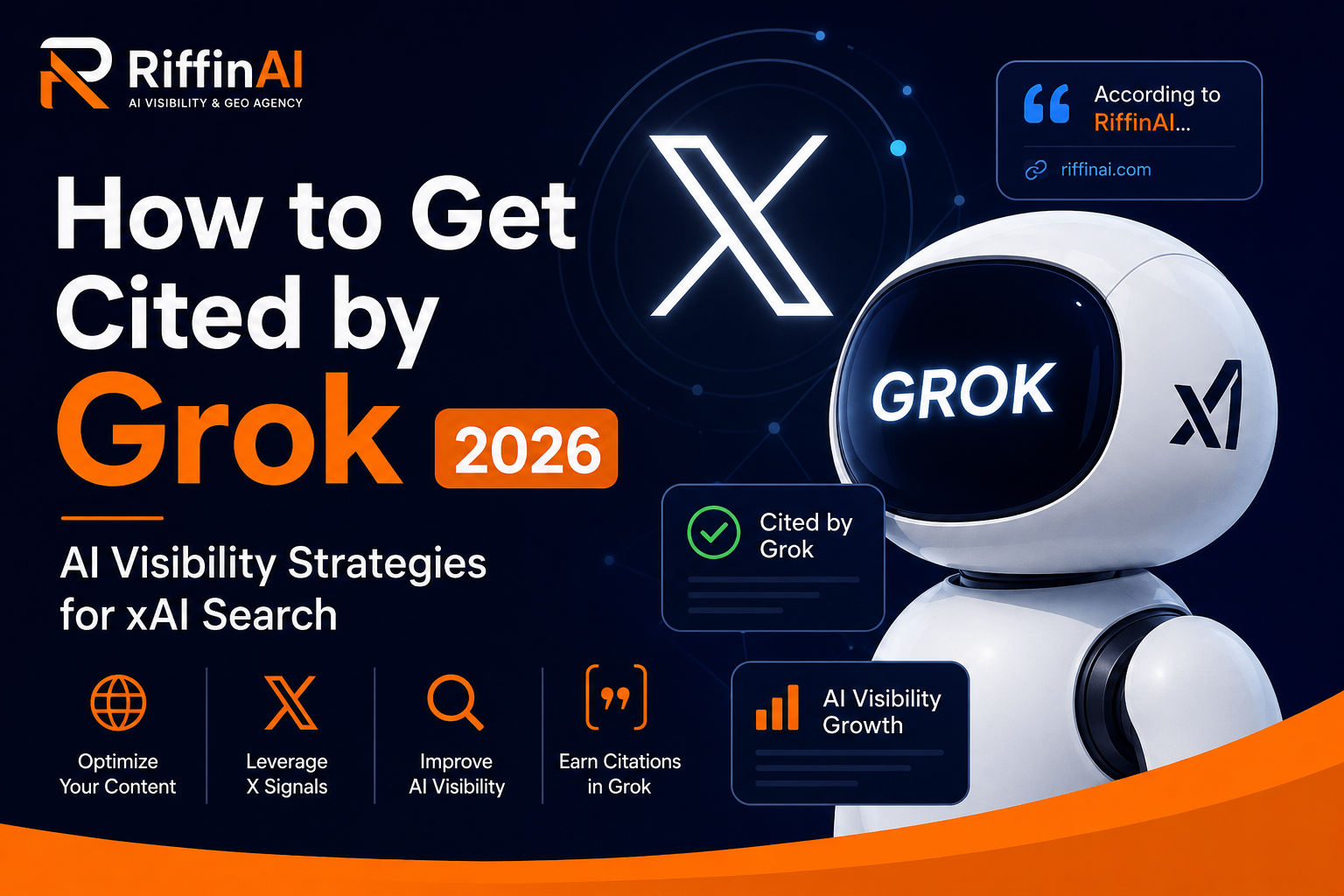

How to Get Cited by Grok is a question more businesses are asking as AI-powered search continues to evolve. As Grok becomes an increasingly important discovery platform, understanding AI Visibility best practices can improve your chances of being cited in AI-generated responses.
Artificial intelligence is changing how people discover information online.
While Google remains a major source of traffic, AI assistants such as ChatGPT, Gemini, Claude, Microsoft Copilot, Perplexity, and Grok are becoming trusted tools for finding answers, comparing products, and recommending businesses.
Among these platforms, Grok, developed by xAI, stands out because of its close integration with X (formerly Twitter) and its ability to incorporate real-time information into responses.
So how can your business improve its chances of being cited by Grok?
The short answer is simple:
Create authoritative, technically accessible, and frequently updated content while building credibility both on your website and on X.
In this guide, we’ll explore the practical strategies that can improve your AI Visibility and help your content become more discoverable by Grok and other AI assistants.
What Is Grok?
Grok is an AI assistant developed by xAI, the artificial intelligence company founded by Elon Musk.
Unlike traditional search engines, Grok generates conversational answers by combining information from multiple sources rather than simply listing webpages.
One of Grok’s distinguishing characteristics is its close relationship with X, allowing it to incorporate timely public information alongside web content.
As AI-powered search continues to evolve, businesses should consider Grok as part of a broader AI Visibility strategy rather than focusing exclusively on traditional search engines.
How Does Grok Find Information?
While xAI has not publicly documented every aspect of Grok’s ranking systems, observations from publishers and publicly available information suggest Grok considers multiple signals when generating responses.
These may include:
- High-quality public web content
- Fresh information
- Authoritative sources
- Structured data
- Clearly organized answers
- Signals from X
- Overall website credibility
Rather than attempting to optimize for one platform, businesses should focus on creating content that is useful, trustworthy, and technically accessible across the AI ecosystem.
Why AI Visibility Matters
Traditional SEO focuses on ranking webpages.
AI Visibility focuses on becoming part of the answer.
Instead of asking Google:
“Best GEO agency in Egypt”
Users increasingly ask AI assistants:
- Who is the best GEO agency?
- Which company specializes in AI Visibility?
- How do I get my business recommended by AI?
The companies cited in those answers gain a significant competitive advantage.
Best Practices to Improve Your Chances of Being Cited by Grok
1. Publish Original Content
Original research consistently outperforms generic content.
Examples include:
- Industry reports
- Case studies
- Surveys
- Benchmarks
- Experiments
- Proprietary frameworks
AI systems often prioritize information that provides unique value rather than repeating existing articles.
2. Use an Answer-First Structure
Each major section should begin by directly answering the reader’s question.
Example:
Question
How do you get cited by Grok?
Answer
Publish authoritative, well-structured content, maintain an active digital presence, and regularly update your information.
Supporting details can then follow.
This structure makes information easier for both users and AI systems to understand.
3. Build Topical Authority
Rather than publishing isolated articles, create comprehensive topic clusters.
For example:
- What Is AI Visibility?
- Generative Engine Optimization (GEO)
- Entity SEO
- AI Search Optimization
- How to Get Cited by ChatGPT
- How to Get Cited by Perplexity
- How to Get Cited by Grok
- Measuring AI Referral Traffic
This interconnected content helps establish expertise.
4. Implement Structured Data
Schema markup helps search engines and AI systems better understand your content.
Useful schema types include:
- Organization
- Article
- BlogPosting
- FAQ
- Breadcrumb
- Person
Structured data improves machine readability and strengthens entity recognition.
5. Build a Strong Presence on X
One characteristic that differentiates Grok from many other AI assistants is its relationship with X.
Publishing thoughtful insights, participating in discussions, and sharing original research on X may increase your overall digital authority.
Instead of posting promotional content exclusively, focus on:
- Original observations
- Industry analysis
- Educational threads
- Research findings
- Commentary supported by evidence
Measuring Grok Traffic in Google Analytics 4
One challenge with AI Visibility is measuring where AI-generated visitors come from.
Unlike traditional search engines, not every AI assistant consistently passes referral information.
Based on observations from publishers and analytics data, some visits originating from Grok or Claude may appear in Google Analytics 4 as:
(direct) / (none)
instead of identifiable referrals.
This occurs when the original referral information is not passed to the destination website.
As a result, Direct traffic may include:
- Users typing your URL directly
- Bookmarks
- Messaging apps
- Email clients
- Privacy-focused browsers
- Some AI assistants that do not consistently preserve referral information
Because of this, it is not possible to accurately determine exactly how much Direct traffic originated from Grok or Claude without additional tracking.
Treat Direct traffic as a mixed traffic source rather than assuming it all came from AI assistants.
How to Better Measure AI Traffic
To build a clearer picture of AI Visibility:
- Monitor identifiable referrals from ChatGPT, Perplexity, Gemini, and Microsoft Copilot.
- Use UTM parameters on links you control.
- Track AI-generated leads, meetings, and customers.
- Compare AI referral trends over time.
- Combine Google Analytics 4 with Microsoft Clarity AI Visibility insights.
Traffic is valuable—but business outcomes matter even more.
Technical Checklist
Before publishing content, verify that:
✅ Website loads quickly
✅ Mobile friendly
✅ HTTPS enabled
✅ XML sitemap submitted
✅ Robots.txt allows legitimate AI crawlers
✅ Article schema implemented
✅ Author profile included
✅ Internal links added
✅ External authority references included
✅ Images optimized
Technical excellence improves accessibility for both search engines and AI systems.
Common Mistakes
Many websites make the same mistakes:
- Publishing thin content
- No structured data
- Outdated articles
- No author information
- Poor internal linking
- Weak topical authority
- No original insights
Fixing these issues improves overall AI Visibility—not just Grok performance.
RiffinAI’s Perspective
At RiffinAI, we’ve observed a consistent pattern across multiple AI platforms:
Content that is:
- Helpful
- Well-structured
- Frequently updated
- Technically optimized
- Supported by evidence
is more likely to be surfaced in AI-generated responses.
Our own analytics have also shown measurable referral traffic from AI assistants including ChatGPT, Perplexity, Gemini, and Manus, demonstrating that AI search is already becoming an important customer acquisition channel.
While every platform uses different ranking systems, creating genuinely useful content remains the most sustainable strategy.
Frequently Asked Questions
Can I optimize specifically for Grok?
You can optimize your website for AI Visibility using structured data, authoritative content, technical SEO, and consistent publishing. These practices may improve visibility across multiple AI assistants, including Grok.
Does X activity matter?
Based on Grok’s integration with X and industry observations, maintaining an active and credible presence on X may strengthen your overall digital authority.
Is Grok SEO different from traditional SEO?
Yes. Traditional SEO focuses on search rankings, while AI Visibility focuses on increasing the likelihood that AI assistants reference or recommend your content. The two approaches complement each other.
Can Google Analytics accurately measure Grok traffic?
Not always. Depending on how referral information is passed, some visits associated with AI assistants may appear as Direct traffic. Use identifiable referrals, UTM parameters where appropriate, and business outcomes alongside analytics to build a more complete picture.
Final Thoughts
Getting cited by Grok isn’t about finding a shortcut or exploiting an algorithm.
It’s about building a trustworthy digital presence through authoritative content, sound technical foundations, and consistent expertise.
The same principles that help your business earn trust from people—clarity, accuracy, originality, and credibility—also make your content more useful for AI systems.
As AI-powered discovery continues to grow, organizations that invest in AI Visibility today will be better positioned to be discovered, referenced, and recommended tomorrow.
Call to Action
Want to understand how visible your business is across AI platforms?
Request a free AI Visibility Audit from RiffinAI and discover how your website performs across ChatGPT, Grok, Gemini, Claude, Microsoft Copilot, Perplexity, and other AI-powered search experiences.