
The search landscape has fundamentally transformed. While traditional search engines like Google still drive substantial traffic, a massive behavioral shift is taking place. Millions of high-intent buyers are bypassing standard blue-link search results entirely. Instead, they are turning to conversational AI platforms to make purchasing decisions.
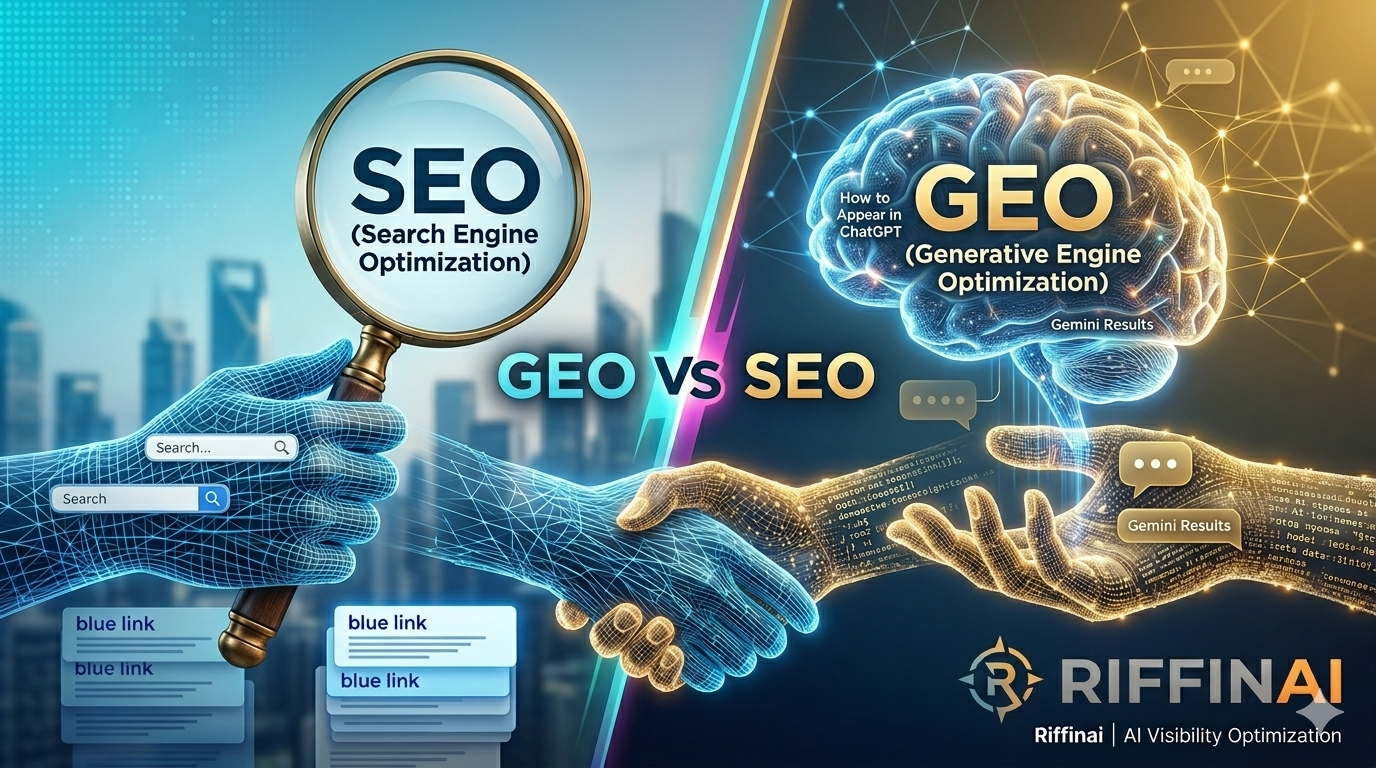
This brings businesses to a critical crossroads: GEO vs SEO.
If you want to know how to appear in ChatGPT, Gemini, or Perplexity results, relying purely on traditional search engine optimization is no longer enough. To survive this paradigm shift, brands must master Generative Engine Optimization (GEO).
In this comprehensive guide, we will break down the structural differences between GEO vs SEO, explore how AI engines aggregate data, and show you exactly how a specialized generative engine optimization agency can secure your brand’s AI visibility optimization.
What is SEO? (Traditional Search Engine Optimization)
Traditional SEO is the practice of optimizing your website to rank as high as possible on traditional search engine results pages (SERPs) like Google or Bing.
SEO focuses primarily on algorithms that evaluate:
- Keyword Matching & Intent: Ensuring your content matches what a user types into a search bar.
- Technical Health: Page speed, mobile-friendliness, secure protocols (HTTPS), and clean site architecture.
- Authority Signals: Backlinks from reputable websites acting as “votes of confidence.”
In the traditional SEO model, success means ranking position #1 to #3 for a high-volume keyword, driving a user to click through to your website.
What is GEO? (Generative Engine Optimization)
Generative Engine Optimization (GEO) is the next evolution of digital marketing. It is the process of optimizing your brand’s digital footprint so that Large Language Models (LLMs)—like OpenAI’s ChatGPT, Google’s Gemini, and Perplexity AI—cite, recommend, and list your business when users ask them questions.
Unlike search engines that return a list of links, generative engines read thousands of sources, synthesize the information, and deliver a single, cohesive answer.
Therefore, GEO isn’t just about ranking your website; it is about optimizing your overall brand visibility across the entire web ecosystem so that AI models perceive your business as the definitive authority.
Key Differences: GEO vs SEO
To successfully adjust your marketing mix, it is essential to understand how these two methodologies differ in practice:
| Feature | Traditional SEO | Generative Engine Optimization (GEO) |
|---|---|---|
| Primary Goal | Drive clicks from SERPs to a specific website. | Get cited, summarized, and recommended by AI models. |
| User Query Style | Short, fragmented phrases (e.g., “best project management software”). | Conversational, long-tail questions (e.g., “Which software should a 10-person remote creative team use for video workflows?”). |
| Content Structure | Long-form blog posts, explicit H2/H3 headers, keyword-dense paragraphs. | Structured data, clear facts, authoritative quotes, statistics, and direct answer formats. |
| Discovery Mechanism | Web crawlers indexing tags, keywords, and domain authority. | Training data pipelines, Retrieval-Augmented Generation (RAG), and live web-browsing APIs. |
| Metric of Success | Organic traffic, Impressions, CTR, and SERP Positions. | Brand Mentions, AI Citation Share, Sentiment Score, and AI Share of Voice. |
Why GEO Matters: The Rise of Conversational AI
Why should your business worry about GEO vs SEO? Because the way consumers research products has evolved.
When a user asks, “how do chatgpt, perplexity, and gemini differ in brand visibility opportunities?”, they are looking for immediate context. They don’t want to click through 5 different blogs to find an answer. They want the engine to summarize the answer for them.
If your brand is not explicitly mentioned or cited in that summarized response, you effectively do not exist to that user. According to emerging search trends, optimizing for AI queries yields up to a 40% increase in brand optimization performance over businesses that stick strictly to legacy SEO strategies.
How to Appear in ChatGPT and Google Gemini: A Step-by-Step Framework
If your goal is to figure out how to show up in ChatGPT results, you need to adapt to how AI engines build their trust. LLMs rely heavily on verification and consensus. Here is the operational framework used by top agencies to achieve AI visibility optimization:
1. Optimize for Retrieval-Augmented Generation (RAG)
Modern AI models don’t just rely on their past training data; they use real-time web-browsing (RAG) to answer questions. To ensure they pull from your site, publish high-authority content featuring unique insights, data-backed statistics, and structured tables. AI engines love scraping structured, data-rich layouts because they are easy to synthesize.
2. Secure Authoritative Digital PR and Mentions
AI models establish trust through consensus. If your company is mentioned on Wikipedia, major news outlets, top-tier industry blogs, and review aggregators like G2 or Trustpilot, the LLM cross-references these nodes. When a user asks for the “best service provider,” the engine scans these third-party platforms to form its answer.
3. Implement Advanced Schema Markup
Ensure your technical foundation is flawless by implementing organizational, product, and author schemas. This allows AI web scrapers to perfectly map your entity relationship, understanding exactly what products you sell, your geographical location, and who your internal experts are.
4. Direct, Fact-Dense Content Formatting
When answering specific user intents, avoid unnecessary filler text. Use direct, authoritative statements. Instead of wrapping an answer in 500 words of introductory fluff, state the answer clearly in the first two sentences, followed by bulleted supporting evidence. This makes it incredibly easy for an LLM to quote your brand directly as a source.
Partnering with a Generative Engine Optimization Agency
Transitioning your digital strategy from traditional SEO to GEO requires entirely new toolsets, tracking methodologies, and content engineering frameworks.
As a dedicated Generative Engine Optimization agency, Riffinai specializes in building your brand’s footprint across AI ecosystems. We don’t just optimize for search algorithms; we optimize for LLM intelligence, helping businesses scale their AI growth stack and agents to maintain a dominant share of voice in AI-driven search models.
Whether you need a comprehensive AI visibility audit to see where you currently stand in ChatGPT, or you want to revamp your content layout to win the GEO vs SEO battle, partnering with specialized AI consultants ensures your brand remains visible where the future is searching.
Frequently Asked Questions (FAQs)
What is the primary difference between SEO and GEO?
SEO focuses on optimizing websites to rank on traditional search engines like Google to secure direct clicks. GEO (Generative Engine Optimization) focuses on optimizing content across the web so that AI engines like ChatGPT and Gemini synthesize and recommend your brand within their conversational answers.
How do I get my business found on ChatGPT?
To get listed in ChatGPT results, your business must establish a strong digital consensus. This includes securing third-party reviews, getting mentioned in authoritative industry publications, implementing clean schema data, and producing factual, structured content that OpenAI’s web-crawling bots can easily reference.
Will GEO completely replace traditional SEO?
No. GEO and SEO complement one another. Traditional search engines still drive foundational transactional traffic, but GEO acts as the critical layer that captures conversational search and high-intent buyers utilizing AI assistants. Integrating both ensures total coverage.
How can I audit my brand’s current AI visibility?
You can execute an AI visibility audit by querying major LLMs with unbranded, high-intent category prompts related to your industry and tracking whether your brand is cited. For an advanced, automated analysis, working with an experienced AI visibility agency allows you to accurately measure your exact AI share of voice across ChatGPT, Perplexity, and Gemini.