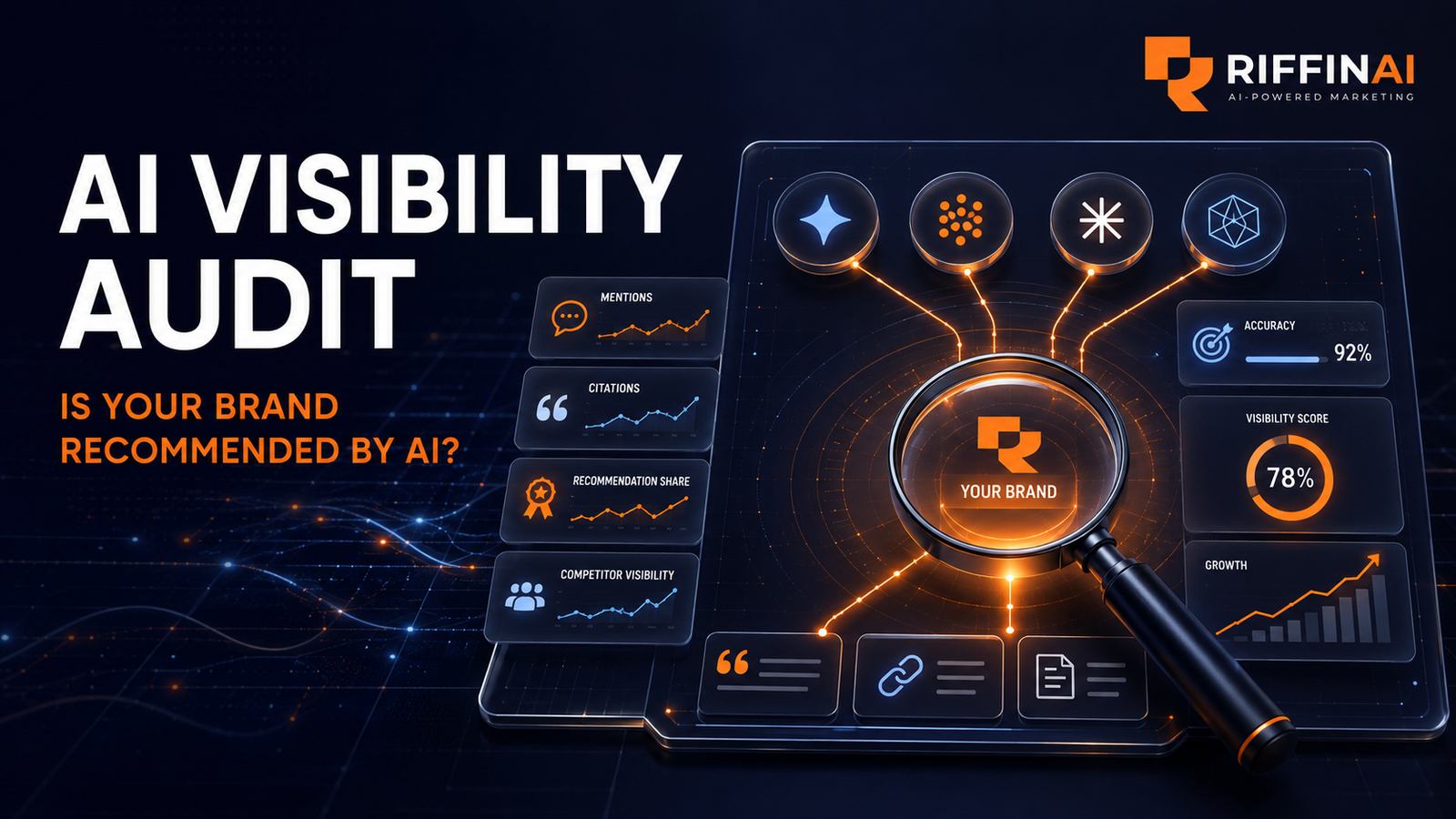

Customers are no longer discovering businesses through Google alone.
They are asking ChatGPT, Gemini, Claude, Perplexity and other AI assistants questions such as:
- What is the best company for this service?
- Which provider should I trust?
- What products would you recommend?
- What is the difference between these companies?
- Which option is best for my budget or location?
The answers can influence which brands customers investigate, compare and contact.
But many companies still do not know whether AI platforms can find their business, understand what it offers or confidently recommend it.
That is exactly what an AI visibility audit is designed to uncover.
An AI visibility audit evaluates how a brand appears across AI-powered search and recommendation platforms. It reveals whether the business is mentioned, cited, accurately described and recommended for the questions that influence customer decisions.
More importantly, it shows what needs to improve before competitors capture those discovery opportunities.
What Is an AI Visibility Audit?
An AI visibility audit is a structured assessment of how a brand, company, product or service appears in answers generated by AI platforms.
It examines whether platforms such as ChatGPT, Gemini, Claude and Perplexity:
- Recognize the brand
- Understand its products and services
- Associate it with the correct industry and location
- Mention it for relevant customer questions
- Cite its website as a source
- Recommend it alongside or ahead of competitors
- Describe its capabilities accurately
- Send qualified visitors to its website
This is different from checking whether a website ranks for a single keyword.
AI assistants can interpret complex, conversational questions. They may combine information from websites, business profiles, authoritative publications, customer reviews and other trusted sources before presenting an answer.
The purpose of the audit is therefore not to check one isolated ranking. It is to measure the brand’s overall presence throughout the AI-assisted customer journey.
Why Businesses Need an AI Visibility Audit
A business can perform well in traditional search results while remaining almost invisible in AI-generated answers.
For example, your website might rank on Google for a service keyword, but ChatGPT may recommend three competitors when asked for the best providers in your market.
Alternatively, an AI assistant might recognize your company but describe its services incorrectly, mention outdated information or fail to provide a link to your website.
These gaps affect more than visibility. They can influence:
- Brand discovery
- Customer trust
- Shortlisting and comparison
- Website traffic
- Qualified leads
- Product consideration
- Sales opportunities
An audit establishes a baseline. Without one, a company cannot confidently determine whether its AI visibility strategy is improving business outcomes.
What Should an AI Visibility Audit Measure?
A useful audit should go beyond searching for the company name. It should evaluate the brand across the questions customers ask before making a decision.
1. Brand Recognition
The first question is whether AI platforms recognize the company as a real and distinct business entity.
The audit should check whether AI systems correctly understand:
- The official company name
- Industry and business category
- Products and services
- Geographic markets
- Website and contact information
- Leadership or founder information
- Areas of specialization
- Relationship between the brand and its products
If these details are unclear or inconsistent across the web, AI systems may struggle to understand the business.
2. Brand Mention Rate
Brand mention rate measures how frequently the company appears across a defined set of commercially relevant prompts.
For example, a GEO agency might test prompts such as:
- What are the best GEO agencies in Egypt?
- Which companies provide AI visibility optimization?
- Who can help my business appear in ChatGPT?
- What agency offers Generative Engine Optimization for enterprises?
- Which AI search optimization agency should I consider?
If the brand appears in two out of twenty relevant answers, its mention rate is 10%.
This provides a more meaningful benchmark than testing one question and assuming the result represents the brand’s overall visibility.
3. Recommendation Share
Being mentioned is useful, but being recommended is more commercially valuable.
Recommendation share measures how often the company is presented as a suitable choice when users ask AI platforms to compare or recommend providers.
The audit should identify whether the brand is:
- Directly recommended
- Included in a shortlist
- Mentioned only as background information
- Excluded while competitors are recommended
- Recommended for the correct customer type
- Associated with the correct problem or outcome
This helps distinguish basic brand awareness from genuine influence during customer decisions.
4. Citation and Source Visibility
AI platforms increasingly use live web search and supporting sources when answering questions.
OpenAI explains that its OAI-SearchBot helps surface websites in ChatGPT search results. Websites that block it may not appear as sources in ChatGPT search answers. ChatGPT referral links can also include tracking information that allows publishers to identify resulting traffic in analytics. (OpenAI crawler documentation, OpenAI publisher guidance)
An audit should therefore examine:
- Whether the brand’s website is cited
- Which pages receive citations
- Which external sources mention the company
- Whether competitors receive more citations
- Whether cited information is accurate and current
- Whether technical restrictions prevent AI search crawlers from accessing the site
Citation visibility matters because a source link can move a user from an AI answer to the company’s website.
5. Accuracy of AI-Generated Information
Visibility is not valuable if the information is wrong.
An audit should document inaccurate or incomplete answers related to:
- Services
- Pricing
- Locations
- Product capabilities
- Target customers
- Company history
- Leadership
- Contact information
- Availability
- Competitive positioning
Incorrect information often reveals a wider entity-consistency problem. The company’s website, profiles and external mentions may contain conflicting or outdated descriptions.
6. Competitor Share of Voice
AI visibility should always be measured within a competitive context.
The audit should identify:
- Which competitors appear most frequently
- Which brands are recommended first
- Which sources support those recommendations
- What topics competitors are associated with
- What evidence makes their positioning stronger
- Which customer questions they currently dominate
The purpose is not to copy competitors. It is to understand why AI platforms have greater confidence in recommending them.
This analysis can expose missing content, weak authority signals, limited third-party validation or unclear positioning.
7. AI Referral Traffic and Conversions
AI visibility should ultimately support business growth.
Website analytics can reveal traffic arriving from sources such as ChatGPT, Gemini and Perplexity. The audit should assess what these visitors do after reaching the website.
Important indicators include:
- AI referral sessions
- Engaged sessions
- Landing pages receiving AI traffic
- Contact-form submissions
- Calls or WhatsApp enquiries
- Audit requests
- Product views
- Assisted conversions
- Lead quality
AI referral traffic may initially be smaller than traditional organic search traffic, but its commercial intent can be significant because users often arrive after discussing their needs with an AI assistant.
How an AI Visibility Audit Works
A professional audit should use a repeatable process rather than a few random searches.
Step 1: Define Commercially Relevant Questions
Begin with the real questions customers ask during discovery, evaluation and purchase.
The prompt set should include:
- Informational questions
- Problem-based questions
- Service discovery
- Provider recommendations
- Product comparisons
- Location-based searches
- Industry-specific searches
- High-intent buying questions
These questions should reflect customer outcomes rather than only the terminology used by the company internally.
Step 2: Test Multiple AI Platforms
The same prompt should be evaluated across several platforms because their answers, sources and search capabilities can differ.
Google confirms that AI Overviews and AI Mode can surface supporting website links and may use multiple related searches to produce answers. Google also states that established SEO fundamentals remain relevant to appearing in these experiences. (Google Search Central)
Claude’s web-search functionality can access current online information and provide cited sources, while Perplexity uses its search systems and crawlers to surface and link relevant web pages. (Anthropic documentation, Perplexity crawler documentation)
Testing only one platform therefore provides an incomplete picture.
Step 3: Record Mentions, Citations and Recommendations
For every prompt and platform, document:
- Whether the brand appeared
- How prominently it appeared
- Whether it was recommended
- Which competitors appeared
- Which sources were cited
- Whether the information was correct
- Whether the answer reflected the intended positioning
Because AI answers can change, the date, location and relevant test conditions should also be recorded.
Step 4: Audit Technical Accessibility
The website must be technically accessible before its content can become a reliable AI-search source.
The technical review should cover:
- Robots.txt rules
- AI search crawler access
- Google indexing
- XML sitemap availability
- Canonical URLs
- Page speed and mobile usability
- Internal linking
- Structured data accuracy
- Important content available as readable text
- CDN or security tools blocking legitimate crawlers
Technical access alone does not guarantee recommendation, but technical barriers can prevent strong content from being discovered.
Step 5: Evaluate Content and Entity Clarity
The audit should determine whether the website clearly answers the questions AI systems and customers need resolved.
This includes reviewing:
- Service pages
- Product information
- About and leadership pages
- Location information
- Case studies
- Comparison content
- FAQs
- Pricing information
- Customer outcomes
- Evidence and supporting claims
A company with vague service descriptions and unsupported claims is more difficult to recommend than one with clear expertise, credible proof and consistent information.
Step 6: Analyze Authority and External Validation
A brand’s own website is only one part of its digital presence.
The audit should also evaluate signals such as:
- Relevant media coverage
- Industry mentions
- Customer reviews
- Professional profiles
- Business directories
- Expert contributions
- Partnerships
- Case studies
- Consistent brand information across trusted sources
External validation can strengthen confidence that the company is established, relevant and credible.
Step 7: Build a Prioritized Improvement Roadmap
The final output should not be a score without context.
It should explain:
- What is limiting visibility
- Which platforms show the largest gaps
- Which competitors are currently stronger
- Which technical issues need correction
- Which pages should be created or improved
- Which authority signals are missing
- How progress will be measured
- Which improvements are most likely to support leads and revenue
This turns the audit from a report into an actionable growth plan.
Is an AI Visibility Audit the Same as an SEO Audit?
No. They are complementary but different.
An SEO audit primarily evaluates a website’s ability to be crawled, indexed and ranked in traditional search results.
An AI visibility audit evaluates whether AI platforms understand, mention, cite and recommend the brand when users ask natural-language questions.
SEO remains essential. Google explicitly states that foundational SEO practices continue to apply to its AI search features. However, AI visibility also requires broader attention to entity clarity, third-party authority, comparison contexts, customer questions and recommendation share.
Businesses increasingly need both.
How Often Should AI Visibility Be Audited?
A complete benchmark can be conducted before beginning an AI visibility or GEO strategy.
After that, priority prompts should be monitored regularly. A monthly or quarterly review is often appropriate, depending on the industry, competitive activity and publishing frequency.
Monitoring matters because:
- AI-generated answers can change
- New competitors can appear
- Sources can be replaced
- Business information can become outdated
- New website content may begin receiving citations
- Platform search capabilities continue to evolve
The objective is not to chase every daily variation. It is to identify meaningful trends over time.
Turn AI Visibility Into Business Growth
An AI visibility score is not the final objective.
The real objective is to help more potential customers discover the business, understand its value, trust its expertise and take the next step.
That requires connecting technical accessibility, content quality, brand authority, customer intent and conversion strategy.
RiffinAI helps companies assess and improve how they appear across ChatGPT, Gemini, Claude, Perplexity and other AI-powered discovery experiences.
Start by using the RiffinAI AI Visibility Audit to discover whether AI platforms can find and understand your brand.
For a deeper assessment, competitor analysis and prioritized implementation roadmap, contact RiffinAI.
Frequently Asked Questions
What is an AI visibility audit?
An AI visibility audit evaluates whether platforms such as ChatGPT, Gemini, Claude and Perplexity can find, understand, mention, cite and recommend a business for commercially relevant customer questions.
How can I check whether ChatGPT recommends my business?
Create a structured set of questions based on your services, industry, location and customer needs. Test the same questions across ChatGPT and other AI platforms, recording brand mentions, recommendations, cited sources, accuracy and competing companies.
What is a good AI visibility score?
There is no universal score that applies equally to every company. A useful score should reflect performance across a defined prompt set, relevant platforms, competitor visibility, citations, accuracy and customer intent. Improvement over a consistent baseline is more meaningful than an isolated number.
Can SEO improve AI visibility?
Yes. Strong technical SEO, crawlability, indexing, internal linking and helpful content support discoverability in traditional and AI-powered search. However, AI visibility also depends on clear brand information, external authority, trustworthy evidence and relevance to conversational customer questions.
How long does Generative Engine Optimization take?
The timeline depends on the website’s current technical condition, content coverage, brand authority and competition. Technical improvements may be implemented quickly, while stronger recognition, citations and recommendations generally require consistent publishing and external validation over time.
Can AI referral traffic be tracked in Google Analytics?
Yes. Traffic from AI platforms can often be identified through referral sources and campaign parameters. Businesses should also track the landing pages, engagement, enquiries and conversions produced by those visitors.